 If you think about the fact that you spend a third of your life sleeping, then the argument to buy a good-quality mattress makes perfect sense. After all, you want comfort and safety for that chunk of your life.
Now, when you take a truck driver, they also spend a good chunk of their working life on the road. So, again, naturally, it seems only logical that you’d want to ensure comfort and safety. And while their trucks are designed for comfort, safety comes in many different forms. One factor that determines truck safety is all the different terrain they have to drive through.
And this article is all about that.
Although driver fatigue or driver error can happen almost anywhere (and anytime), the biggest, most predictable cause of truck crashes in a region is often the geography of the respective state.
To illustrate all of this, we’ll use these three states as comparison examples – Wyoming, Florida, and California – and go on to show you how these three distinctly different terrains affect truck safety.
Wyoming
A truck driver’s opponent here is the sky and the earth.
Landscaped by high plains, treacherous mountain passes, and the endless, exposed lanes along I-80 (a crucial artery for coast-to-coast shipping), the city itself is a perfect minefield of environmental hazards.
Stability and elemental control are the main risks here, but do you know what poses the most recognizable danger?
The wind.
Gusts on the plains that sweep the open fields don’t just push a vehicle; they can lift a trailer’s high-profile box and make it like a sail. A blast at the wrong period, particularly around notorious wind tunnels like Elk Mountain, can blow an entire semi-loaded truck onto its side quickly, with little warning to those that follow behind. In the presence of wind, we get the deadly mix of ice and altitude.
The mountain passes turn into slick traps.
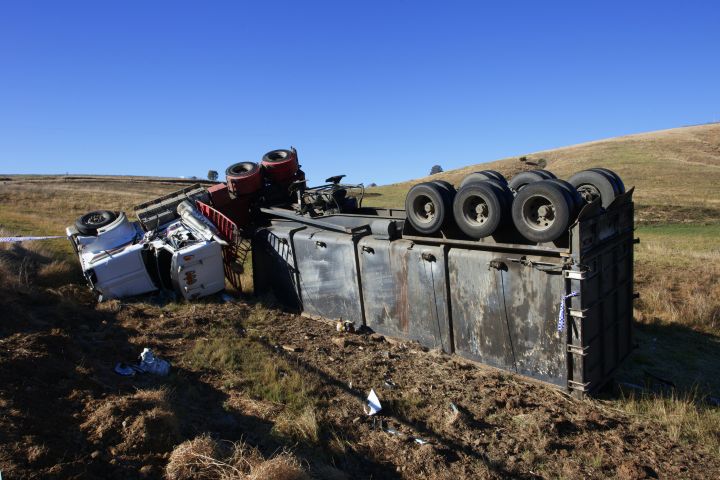
For trucks, the risks are doubled. Tires slip onto black ice, and constant braking during lengthy descents results in catastrophic brake fade, when the braking system gets overheated and fails altogether.
This isn’t just a matter of losing control; it’s a runaway vehicle.
Combine that with the remoteness of Wyoming’s highways, and it adds a layer of fear to these risks. Long distances between services can leave drivers fatigued, and an accident of this nature causes delayed emergency response and complicated investigations.
Pertinent evidence, like skid marks or vehicle positioning, can be lost with the following snow blowing over the road or another snowfall.
If you find yourself in this situation, you could call a Wyoming truck accident law firm to assign you a lawyer who specializes in these types of cases and can help/advise you about your next move.
Florida
Florida’s risk comes in different forms, and instead of strictly terrain-related, it suddenly also includes a social risk – congestion and unpredictable driver behavior.
This mostly has to do with the fact that Florida is mostly an urban state and tourism flourishes there (especially during summer), and if you’re a truck driver, you already know this. Long lines, frequent stop-and-go situations. It’s not fun. But the ‘not fun’ part isn’t dangerous. It’s the recklessness and aggression that come with being stuck in a jam for too long, especially when the scorching sun is hitting you from all sides.
Florida isn’t called the Sunshine State for no reason. When you get the sun rise from behind the Atlantic each day, you can be sure it’ll be warm (too warm sometimes). Drivers overtaking, drivers changing lanes without checking, even brake checking you, the truck driver, because somehow the huge congestion is your fault.
There are lots of situations where dangerous driving could be a factor for safety here.
And you might think, “Why do I care? I’m safe in my big, huge truck”, and that is true. But you’re still there, having to deal with the aftermath of an accident, regardless of how you go or feel about it.
California
In California, you’re faced with a cornucopia of terrains.
It features severe mountain passes and is among the most congested urban areas in the country. The area is layered with vast desert areas, and all of these are very trying on the mechanics of a truck. The mountain pass is California’s typical truck hazard. Long, cragged gradients such as the Grapevine (I-5) or the ascent to Donner Pass (I-80) are infamous for brake failure.
Pushing through intricate, jumbled interchanges and packed warehouse districts requires a constant presence of mind. The practice of lane-splitting by motorcycles, legal in California, is another dynamic for truck drivers to keep an eye on in congested traffic.
California’s Central Valley comes with its own hazard in the form of heavy and thick (and sudden) tule fog, which more often than not brings visibility down to almost zero.
And, as you can imagine, that isn’t ideal (or safe).
Because of this, an immediate danger of cross-cutting is being introduced, where you could easily face a massive pileup of multiple trucks with lots more cars following behind them, which could lead to frustration and extremely dangerous and reckless overtaking maneuvers.
Keep in mind that not everyone is driving a Ferrari, and overtaking two full truck lengths (trailer included) is VERY long.
Add to that two or three cars that don’t want to overtake the trucks for whatever reason, and the truck drivers not leaving enough room between themselves, and you’ve got yourself what feels like a mile in terms of overtaking distance. If a car comes your way, there’s not much you can do about it now, is there?
Conclusion
Having prior terrain knowledge will shape your decisions about the route.
Giving a struggling truck a greater berth on a Wyoming climb, avoiding blind spots in Florida traffic, and for the little guys on the road, never, ever cut in front of a semi at the bottom of a California mountain descent.
The road is a national network, but its hazards are deeply local. Safe (truck) driving!