 When your machinery runs smoothly at 10,000 RPM without a hint of vibration, you rarely think about the tiny components making it possible. Precision ball bearings are the unsung heroes of modern industry, enabling everything from aerospace systems to medical devices to operate with microscopic accuracy. But what separates a high-quality bearing from an ordinary one? The answer lies in a meticulous manufacturing process where every micron matters.
Understanding Precision Ball Bearings and Their Critical Role in Industrial Applications
Precision ball bearings represent the pinnacle of mechanical engineering in miniature form. These components reduce friction between moving parts while supporting both radial and axial loads with exceptional accuracy. Unlike standard bearings designed for general purposes, precision variants must meet stringent specifications where even the slightest deviation can compromise performance.
What Makes Precision Ball Bearings Different from Standard Bearings
The distinction comes down to tolerance levels and manufacturing precision. Standard bearings might have tolerances measured in hundredths of a millimeter, but precision variants operate within tolerances of just a few microns. This extraordinary accuracy ensures consistent performance under demanding conditions, whether in high-speed spindles or sensitive measuring instruments. The precision bearing tolerance levels determine classifications ranging from ABEC 1 to ABEC 9, with higher numbers indicating tighter tolerances and superior performance characteristics.
Industries That Depend on High Precision Bearing Standards
Aerospace applications demand bearings that withstand extreme temperatures and G-forces. Medical equipment requires components that operate silently and reliably for thousands of hours. Machine tool spindles need bearings that maintain dimensional accuracy even under continuous high-speed rotation. These diverse applications all share one requirement: unwavering quality from the manufacturing floor to final installation.
Raw Material Selection: The Foundation of Quality Steel Ball Bearing Materials
Every exceptional bearing begins with superior raw materials. The steel composition determines how the finished product will perform under stress, heat, and time. Manufacturers select alloys based on specific application requirements, balancing hardness, toughness, and corrosion resistance.
Chrome Steel vs. Stainless Steel: Material Considerations
Chrome steel, typically 52100 grade, offers exceptional hardness and wear resistance after heat treatment. This makes it ideal for most industrial applications where performance trumps environmental concerns. Stainless steel variants sacrifice some hardness for superior corrosion resistance, making them invaluable in food processing, marine environments, and chemical plants. When selecting options to buy bearings online, understanding these material differences helps match components to specific operating conditions.
The Rise of Ceramic Ball Bearings Manufacturing
Silicon nitride and zirconia ceramics have revolutionized bearing technology. Ceramic ball bearings manufacturing produces components that weigh 60% less than steel equivalents while offering superior hardness and thermal stability. These advanced materials enable higher speeds, reduce lubrication needs, and extend service life in aggressive environments. The trade-off? Higher initial costs that pay dividends through reduced maintenance and longer operational lifespans.
Material Testing and Certification Requirements
Before materials enter production, they undergo rigorous testing. Spectroscopy confirms chemical composition, while hardness testing verifies heat treatment effectiveness. Microscopic examination reveals grain structure uniformity, and non-destructive testing identifies internal flaws. This quality assurance foundation ensures that only materials meeting high precision bearing standards proceed to manufacturing.
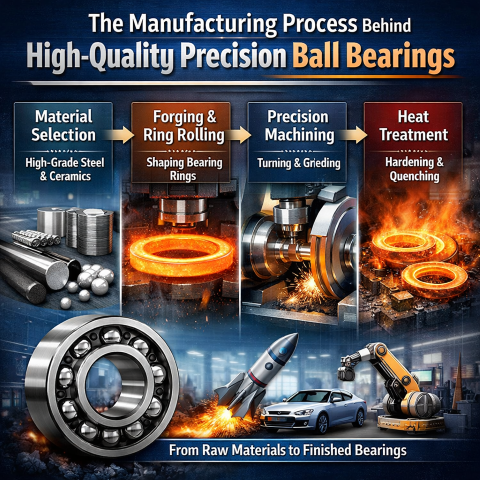
The Precision Bearing Manufacturing Process: From Raw Material to Finished Product
Transforming raw steel into precision components requires a carefully orchestrated sequence of operations. Each step in the ball bearing production techniques builds upon the previous one, progressively refining the material into its final form.
Forging and Ring Forming in Ball Bearing Production Techniques
The process begins with forging steel bars into rough ring shapes. Hot forging aligns the material’s grain structure, enhancing strength and durability. These rough forgings then undergo turning operations that establish basic dimensions, leaving sufficient material for subsequent finishing operations. The goal isn’t perfection yet—it’s creating a stable foundation for precision work ahead.
Bearing Heat Treatment Methods for Optimal Hardness and Durability
Heat treatment transforms bearing steel’s molecular structure. Rings are heated to approximately 840°C, held at temperature to achieve uniform heating, then rapidly quenched in oil. This creates a hard martensitic structure. Tempering follows, reducing internal stresses while maintaining hardness. The result? Steel that achieves 58-65 HRC hardness, providing the wear resistance precision bearings demand. Temperature control during this phase must remain within tight windows—variations of just a few degrees can compromise final properties.
Bearing Grinding and Polishing: Achieving Microscopic Precision
After heat treatment, grinding operations refine dimensions to final tolerances. Centerless grinding machines remove hardened material in controlled increments, achieving surface finishes measured in microinches. Multiple grinding passes with progressively finer abrasives create the mirror-smooth surfaces that minimize friction. Super-finishing operations follow, using extremely fine abrasive films to achieve surface roughness values below 0.05 micrometers. This level of smoothness is essential for applications requiring waterproof bearings and sealed environments where surface imperfections could compromise seal integrity.
Ball Manufacturing and Sphericity Standards
Ball manufacturing follows its own specialized path. Wire or rod stock feeds into heading machines that form rough ball blanks. These undergo heat treatment, then progress through multiple grinding operations. Lapping between flat plates with progressively finer compounds gradually achieves perfect sphericity. Grade 3 balls, used in the finest precision bearings, maintain sphericity within 0.08 micrometers—about one-thousandth the width of a human hair.
Race Finishing and Surface Quality Control
The races where balls travel receive similar attention. Grinding establishes the precise curvature and position, while honing removes any grinding marks and achieves final surface quality. Oscillating motions during finishing prevent directional patterns that could affect ball motion. The finished races must present perfectly uniform contact surfaces without waviness or irregularities.
Critical Bearing Assembly Procedures for Maximum Performance
Assembly transforms individual components into functional units. This seemingly simple step requires careful attention to detail and cleanliness standards rivaling semiconductor manufacturing.
Cage Installation and Material Selection
Cages separate and guide balls around the raceway. Pressed steel cages suit standard applications, while machined brass or phenolic resin cages serve specialized needs. Installation requires precise alignment to ensure even ball spacing and smooth rotation. The cage design affects lubrication flow, noise characteristics, and maximum operating speed.
Lubrication Application During Assembly
Initial lubrication happens in controlled environments. Grease application must achieve complete coverage without excess that could cause churning resistance. Oil-lubricated bearings receive a measured amount ensuring adequate initial protection. The lubricant type—mineral oil, synthetic, or grease—depends on operating temperature, speed, and environmental conditions.
Precision Fitting and Clearance Adjustment
Internal clearance—the amount balls can move within races—critically affects performance. Too tight, and the bearing generates excess heat. Too loose, and vibration increases while precision suffers. Manufacturers measure and adjust clearance through selective assembly, matching components to achieve specified values. Some applications require preloading, where bearings are assembled with negative clearance to maximize rigidity.
Bearing Quality Control Inspection: Ensuring Excellence at Every Stage
Quality control permeates every manufacturing stage, but final inspection provides the ultimate verification that products meet specifications.
Dimensional Accuracy and Precision Bearing Tolerance Levels
Coordinate measuring machines verify bore diameter, outer diameter, width, and raceway position with sub-micron accuracy. Statistical process control monitors these measurements, detecting trends before parts drift out of specification. Each bearing receives dimensional verification, with data recorded for traceability.
Noise and Vibration Testing Protocols
Acoustic testing reveals manufacturing defects invisible to dimensional measurement. Bearings rotate at specified speeds while sensitive microphones detect unusual sounds indicating surface imperfections or contamination. Vibration sensors measure acceleration in three axes, identifying imbalance or waviness. The bearing quality control inspection process rejects any unit exceeding established noise or vibration thresholds.
Load Rating Verification and Performance Testing
Sample testing validates load ratings through accelerated life tests. Bearings run under elevated loads and speeds, accumulating equivalent operating hours in compressed timeframes. Testing continues until failure, providing data on fatigue life and failure modes. This information validates design calculations and identifies potential improvements.
Final Visual and Automated Inspection Systems
Human inspectors examine bearings under magnification, checking for surface defects, proper markings, and assembly quality. Automated vision systems complement human inspection, using high-resolution cameras and image processing to detect microscopic flaws at production speeds. Only bearings passing all inspections proceed to packaging and shipment.
How Does Manufacturing Quality Impact Precision Ball Bearing Performance and Longevity?
The relationship between manufacturing quality and bearing performance isn’t linear—it’s exponential. Small improvements in surface finish can double service life. Tighter dimensional control enables higher speeds and quieter operation. Superior materials withstand harsher environments without premature failure.
Understanding this manufacturing journey helps in selecting the right components for your applications. Whether specifying bearings for a new design or replacing existing units, recognizing quality indicators ensures you receive products delivering the performance your equipment demands. The precision bearing manufacturing process represents a perfect marriage of metallurgy, mechanical engineering, and quality control—one that continues evolving as industries push performance boundaries ever higher.