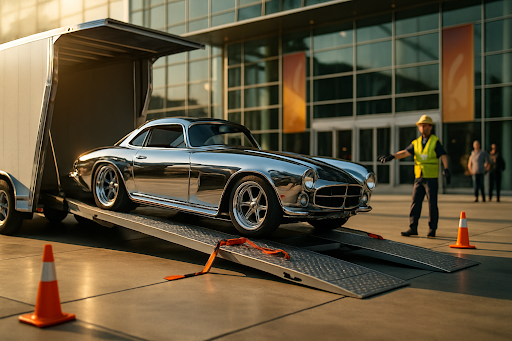
The four most proven ways to ship custom builds fast involve leveraging on-demand dispatch speed, matching flexible trailer configurations to vehicle clearance, eliminating terminal transfers to reduce damage risks, and utilizing direct door-to-show-floor delivery methods.
These specialized transport strategies solve the logistical nightmare of moving a finished vehicle across the country on a tight deadline.
By moving away from standard consolidated freight and adopting dedicated hauling solutions, builders can guarantee their extensive fabrication and paint work survives the journey intact.
When a build is finally done just days before a major event like SEMA, a major logistical hurdle often remains.
The car might be sitting in a garage in Atlanta, while the Las Vegas Convention Center is 1,800 miles away. Standard freight typically quotes a 10-day window, and enclosed trailers book up months in advance. The clock does not stop for logistical delays.
This is the moment where transport decisions become critical. Years of fabrication, a high-end paint job, and a show floor slot depend entirely on how that build gets from the driveway to the event.
Dedicated transport solutions have become the go-to choice for serious builders who cannot afford delays, damage, or logistical guesswork. Here are four reasons why this method belongs at the top of a pre-show checklist.
What Is Hot Shot Trucking?
Hot shot trucking involves transporting time-sensitive, specialized freight using medium-duty trucks and trailers.
It focuses heavily on expedited delivery, giving a vehicle its own dedicated haul, driver, and departure window.
A CDL is required if the combined GVWR of the truck and trailer exceeds 26,000 pounds, ensuring these rigs are operated by qualified professionals. For custom builders seeking reliable solutions, Titan Worldwide’s hotshot trucking represents the type of dedicated movement required for time-critical loads.
The contrast with standard freight matters immensely in this specific context. LTL carriers consolidate multiple shipments and run on their schedule, not the builder’s specific timeline.
Full truckload carriers are built for massive volume rather than specialized care. Neither is designed with a high-value, show-quality build in mind.
This is the same method that construction crews use to move critical equipment to job sites overnight. It is also what renewable energy teams use to rush components to wind farm installations.
Hot shot trucking is a sector of the trucking industry that focuses on expedited delivery across all fields. For custom builders, it translates simply into the build moving exactly when it needs to move.
| Key Insight:
The true value of hot shot trucking isn’t just speed, it is exclusivity. Your custom build gets a dedicated rig, its own driver, and a departure window tailored completely to your schedule. |
1. Speed That Matches Your Show Deadline
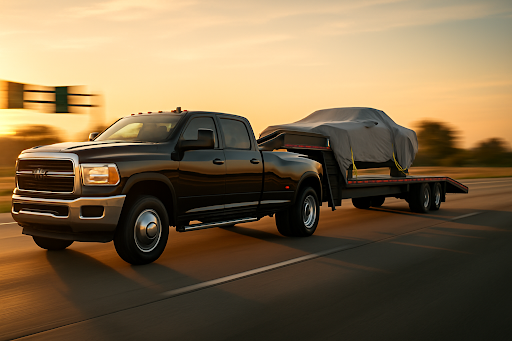
Show deadlines do not negotiate under any circumstances. The gates open when they open, judging starts when it starts, and a build needs to be there before any of that happens.
A custom vehicle must be fully detailed, positioned, and ready well in advance of the crowds arriving. Standard freight timelines are built around carrier convenience rather than event calendars.
Routes get consolidated, loads get held at terminals, and a quoted five-day window can quietly become seven with no explanation.
For a builder finishing final details the week before an event, that gap is simply unacceptable. Expedited transport operates on demand, avoiding these traditional pitfalls completely.
Loads dispatch quickly because a dedicated rig is assigned to the haul rather than slotted into a shared route. That speed is the structural difference between how dedicated freight and consolidated freight operate.
With top-tier providers boasting high on-time delivery rates, rapid dispatch becomes a repeatable operational capability. Speed is the margin between arriving ready and arriving rattled.
2. Flexibility Built for the Show Circuit
No two builds ship the exact same way. A slammed show truck with six inches of clearance loads differently than a wide-body muscle car with carbon panels.
A full tube-chassis race build has different tie-down requirements than a bagged air-ride cruiser. A trailer that works for one might not work for the other.
Dedicated transport offers genuine flexibility across vehicle types, trailer configurations, and departure timing. Gooseneck trailers, flatbeds, step decks, and enclosed options can all be properly matched to the specific load.
This means the rig gets the right equipment for its unique geometry. Scheduling flexibility is equally critical for builders working down to the absolute wire.
When final parts arrive late, and a build is not buttoned up until right before departure, a carrier running a fixed route calendar cannot adapt.
Expedited shipping works gracefully around the builder’s timeline. That last-minute car shipping capability is a core feature of how the service is structured. Nationwide coverage ensures the same logistics standards apply whether the event is in Ontario or Texas.
3. Fewer Hands on Your Build Means Less Risk
Custom paint does not survive careless handling from overworked freight teams. Carbon body panels do not bounce back from dock workers rushing to move heavy pallets.
Hand-fabricated details like one-off mirrors or stretched fenders are not replaceable at any price if scratched or bent. Every single transfer point in traditional freight is a massive risk point.
LTL and terminal-based carriers move loads through multiple handling events during a standard cross-country trip.
Vehicles are loaded onto a truck, transferred at a regional hub, consolidated with other freight, and unloaded at a destination terminal. Each step is an unnecessary opportunity for permanent damage. Dedicated transport eliminates the logistics chain completely.
The build is loaded exactly once, transported directly, and unloaded carefully at the destination. There is one driver, one haul, and absolutely no strangers touching the car between the shop and the event.
For the custom car community, this is a strict matter of respect for the craft. Premium transport models back this reduced-handling approach with comprehensive insurance coverage for ultimate peace of mind.
| Warning/Important:
Avoid standard freight terminals at all costs. Every single transfer point increases the risk of damage to custom paint, carbon panels, and one-off fabricated details. Demand point-to-point transport. |
4. Door-to-Door Delivery Right to the Show Floor
The ideal transport scenario involves a build rolling off the trailer at the exact specified address. It should arrive perfectly on time, without the builder having to drive across town to retrieve it from a freight terminal.
Terminal-based freight creates logistical chaos around events that are already highly stressful. Show weekend mornings are definitely not the time to coordinate a complicated freight pickup run.
Outdoor show fields are simply not set up to receive commercial freight deliveries efficiently. That precious time and energy belong strictly to final detailing and booth setup.
Direct transport is point-to-point by design, avoiding terminal delays entirely. Pickup happens right at the garage, shop, or fabricator’s bay.
Delivery goes directly to the event venue, paddock, or designated drop zone without hesitation. The driver completes the job at the final destination smoothly and professionally.
Top-tier transport logistics providers operate with low customer-to-representative ratios for this exact reason. This ensures a dedicated team member manages the haul in real time to solve problems before they impact the schedule.
Real Builds, Real Deadlines: Scenarios From the Show Season
Scenario A: The Cross-Country Haul
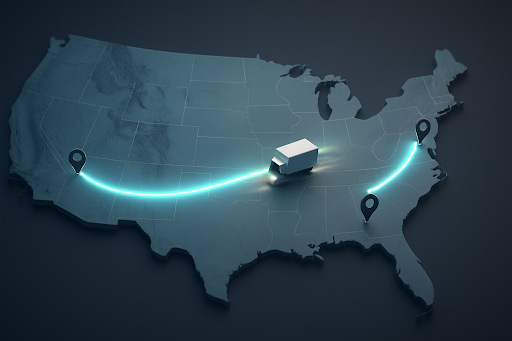
A builder in the Southeast finishes a pro-touring restomod five days before a major West Coast show. Standard freight quotes a 10-day window, which simply will not work for the strict itinerary.
Dedicated dispatch moves the rig within 24 hours, running the build directly across 1,800 miles. It delivers with two full days to spare, providing enough time for final detailing before judging actually begins.
Scenario B: The Last-Minute Save
A fabricator’s final components arrive just three days before an important networking event. The build is not fully buttoned up until 36 hours before the show gates securely open.
A same-day booking gets the vehicle carefully loaded and moving overnight. It arrives at the event venue strictly on time, bypassing the lengthy delays of standard freight terminals.
What to Look for in a Logistics Partner
Knowing what expedited transport offers is half the equation; understanding carrier capabilities is the other crucial half. Large brokers often route builds through massive systems not designed for high-value custom car transport.
A true benchmark for evaluating logistics partners involves carefully looking at concrete operational data.
When analyzing why certain carriers become industry standards, the numbers outline the necessary professional infrastructure.
High on-time delivery rates are a critical starting point to measure operational success. Look for these essential traits when vetting a dedicated haul provider:
- High on-time delivery rates exceeding standard freight industry norms ensure rapid dispatch for urgent logistics.
- Expansive networks with access to tens of thousands of drivers enable repeatable operational capability across North America.
- Comprehensive insurance coverage ensures full protection plus additional liability coverage for highly customized, high-value cargo.
- Dedicated account management with low customer-to-representative ratios guarantees direct access to actual decision-makers.
Approaching custom car transport with this level of dedicated attention ensures high-stakes hauls are managed professionally.
Proactive communication and strict accountability must be present at every single step of the journey. Builders should never settle for less when shipping their priceless automotive masterpieces.
4 Quick Steps To Get Your Build Moving
Step 1: Prep Your Build
Document exact dimensions, ground clearance specs, tie-down points, and any special loading requirements before securing a carrier.
Providing highly exact details upfront ensures an accurate trailer match for safety. This specifically prevents dangerous delays on moving day when the wrong equipment unexpectedly shows up.
Step 2: Book Early or Call for Last-Minute
Provide the pickup location, exact destination address, and mandatory event date clearly. Professional logistics providers will match the right trailer configuration to the specific load based on the build’s geometry.
Practical options usually include flatbeds, goosenecks, step decks, or fully enclosed trailers.
Step 3: Track in Real Time
Utilize dedicated team members to maintain active communication throughout the transit timeline.
Eliminating radio silence between pickup and delivery gives builders immense peace of mind. If anything changes on the scheduled route, it is communicated long before it becomes a serious problem.
Step 4: Receive and Roll
The build safely arrives at the event location directly on schedule. It is immediately ready for setup, final detailing, and gorgeous display to the public. Because transport logistics are handled flawlessly, your team’s focus remains entirely on dominating the show itself.
| Pro Tip:
Always document your exact ground clearance specs and tie-down points before booking. A slammed show truck and a wide-body muscle car require entirely different trailer setups to load safely. |
Ready To Get Your Build to the Show Floor on Time?
A custom build spends months, and very often years, isolated in the shop. Every hour of fabrication and every layer of paint represents deliberate decisions made by highly dedicated craftsmen.
Transport standards must consistently reflect that same level of profound care and attention. Gambling on standard freight timelines designed for general commerce introduces entirely unnecessary risk.
Treating transport as an integral part of the overarching event strategy securely protects your heavy investment. A planned, professional haul executed by a capable logistics partner makes all the difference in the world.
Dedicated transport services are purposefully built for fast freight delivery, flexible scheduling, and heavily reduced handling.
Treating logistics as a core component of the build process ensures the vehicle arrives perfectly intact. Show season does not wait for anyone, and neither should your hard-earned build.