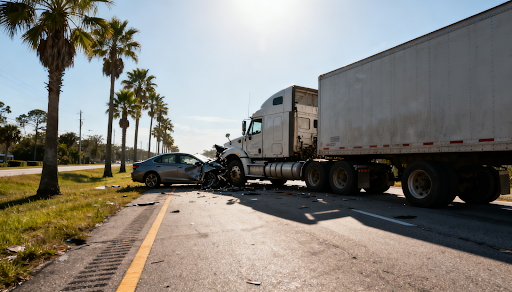
 If you drive in Tampa, you share the road with thousands of commercial trucks every day. Tractor-trailers roll through the I-4/I-275 interchange, line up along Adamo Drive, and crowd the causeways connecting Tampa to St. Petersburg. Florida ranks third in the nation for fatal truck crashes, behind only Texas and California, and the Tampa Bay area sits in the middle of that problem. Port Tampa Bay feeds a steady stream of freight haulers onto local highways, mixing 80,000-pound rigs with sedans and SUVs.
Why trucks are a different kind of danger
A loaded semi can weigh 20 to 30 times more than a passenger car. According to the Federal Motor Carrier Safety Administration (FMCSA), a fully loaded tractor-trailer traveling at 65 mph needs roughly 600 feet to stop, about the length of two football fields. A typical car at the same speed stops in 300 feet. That gap matters every time you cut in front of a truck or follow one too closely.
Big rigs also have blind spots on all four sides. If you cannot see the truck’s mirrors, assume the driver cannot see you. Nationally, about 70 percent of people killed in truck-versus-car crashes are in the smaller vehicle. In Florida, truck-related deaths account for roughly 12 percent of all roadway fatalities, above the national average.
Tampa-specific risks
Tampa’s road network creates particular hazards. Interstate 4 has been called one of the most dangerous highways in the country, with roughly 1.41 fatalities per mile over a six-year study period. The I-4/I-275 interchange, nicknamed “Malfunction Junction,” funnels commuters, freight haulers, and tourists into a cramped series of merges. Sections of I-275 near the Howard Frankland Bridge carry heavy truck volumes too.
Summer thunderstorms make things worse. Sudden downpours reduce visibility and create standing water on low-lying highway sections, which stretches stopping distances for trucks even further. Tampa’s heat also raises the risk of tire blowouts on rigs with deferred maintenance.
Staying safe around big rigs
Most truck-related crashes come down to preventable mistakes. but when they do happen, liability can become complicated. Understanding how fault is determined in intersection accidents can help drivers protect themselves both on the road and after a collision. Give trucks room: leave at least four to five seconds of following distance so you have time to react if the truck brakes suddenly or a tire blows. When passing, do not linger beside the trailer. Accelerate steadily and get clear of the blind spot on the left side. Never pass on the right, where the blind spot is largest.
Do not merge directly in front of a truck and then slow down. Make sure you can see both of the truck’s headlights in your rearview mirror before moving into its lane. Watch for wide right turns at intersections, and stay especially alert in construction zones where lane shifts narrow the space trucks have to work with.
What to do after a truck crash
The steps you take in the first hours after a collision with a commercial truck can shape the outcome of any legal claim.
Call 911 immediately. Florida Statute §316.065 requires you to report any crash involving injuries or property damage over $500. The responding officer’s report becomes a foundational piece of evidence.
See a doctor, even if you feel fine. Adrenaline masks pain, and injuries like concussions or internal bleeding may not show symptoms for hours. Florida’s Personal Injury Protection (PIP) law requires you to get medical treatment within 14 days of crash or you lose coverage under your own policy.
Document the scene with your phone. Photograph vehicle damage, skid marks, road conditions and your injuries. Get names and numbers from witnesses before they leave. Do not apologize or admit fault, because even a casual “I’m sorry” can be twisted into an admission later.
Talk to a lawyer before you talk to trucking company’s insurer. These claims are far more complicated than a standard car crash. Multiple parties may share liability: the driver, the trucking company, the cargo loader, even vehicle manufacturer. Federal regulations from FMCSA govern hours-of-service limits, maintenance standards, and driver qualifications, and violations of those rules can be strong evidence of negligence. An experienced Tampa truck accident lawyer can preserve time-sensitive evidence like truck’s electronic logging device data and black box records before the trucking company has a chance to destroy them.
The clock is ticking
Tampa drivers cannot avoid big rigs. The freight economy depends on them. But you can control how you drive around them, and you can protect yourself if a crash happens. Stay out of blind spots, give trucks space their weight demands, and if a collision occurs, document scene, get to a doctor, and talk to an attorney who handles trucking cases before two-year statute of limitations runs out.