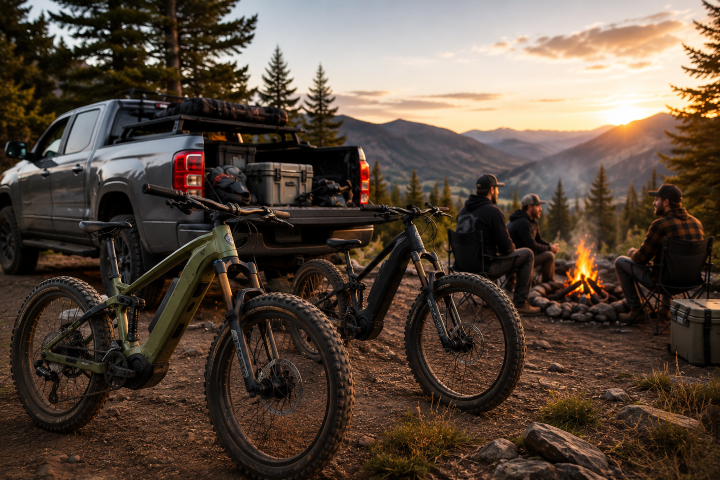
 Somewhere between the tailgate and the trailhead, a new piece of gear started showing up in truck beds across the country. It does not burn fuel. It does not need its own trailer. And it is quietly changing how off-road truck owners cover that last stretch of dirt into camp.
For a crowd raised on displacement and torque curves, the idea took some warming up to. Plenty of guys laughed it off the first time they saw one strapped behind the cab. Then the math kept making sense, the trail kept getting quieter, and the laughing mostly stopped.
This is not a story about replacing your truck. It is about what is riding along with it.
What Is an Off-Road E-Bike?
An off-road electric bike is a pedal bike fitted with an electric motor and battery, built specifically for dirt, gravel, sand, and rough terrain instead of pavement. It pairs a reinforced frame, wide knobby or fat tires, and real suspension with a motor that either assists your pedaling or drives the wheel directly. The result is a machine that covers ground a normal bike never could, without the weight and noise of a powersport vehicle.
Most off-road e-bikes fall into one of three classes. Class 1 assists only while you pedal, up to around 20 mph. Class 2 adds a throttle so you can move without pedaling. Class 3 raises pedal-assist speed to roughly 28 mph. The class matters more than it sounds, because it often decides which trails and public lands you can legally ride.
Compared to a mountain bike, the difference is range and effort. A capable off-road e-bike can haul a rider plus a load of gear up a long grade without that rider arriving soaked and gassed. Compared to an ATV or a dirt bike, the difference is weight, noise, and footprint. That last part is exactly why the overland, hunting, and truck-camp crowds started paying attention.
Why the Truck and Overland Crowd Took Notice
Truck culture and outdoor culture have always overlapped, but the overlap has gotten tighter. Look at the rigs winning attention at shows like the purpose-built off-road truck builds rolling through Pomona each year. More of them are set up to actually go somewhere, not just sit on a stand. Lifted suspensions, bed racks, rooftop tents, and recovery gear point at the same thing: people want to drive past the pavement and stay out there a while.
The same shift shows up at events that blend camping with car culture, where the weekend is as much about the campsite as the show field. Once you are parked deep in the backcountry with a tent up and a fire going, the truck becomes basecamp. And basecamp has a problem every overlander knows well. You do not want to break camp and fire up the rig every time you need to scout a road, check a spot, or run back to a trailhead a few miles off.
That gap is where the e-bike slid in.
There is also a quieter trend underneath it. Enthusiasts who once swore by mechanical everything have warmed up to electronics, sensors, and battery power in ways that would have been unthinkable a decade ago. You can see it in the wider move toward plug-and-play vehicle technology across the aftermarket. A guy comfortable plugging a tuner into his OBD2 port is not going to flinch at a torque sensor on a bike. The cultural resistance to “electric” has been wearing down for a while.
Off-Road E-Bike vs. ATV vs. Dirt Bike
For decades, the answer to “how do I get around once the truck is parked” was an ATV or a dirt bike on a trailer. Both still have their place. But they solve the problem with a lot more weight, noise, and cost than some riders need. Here is how the three stack up for the trail-companion role.
| Factor | Off-Road E-Bike | ATV | Dirt Bike |
| Typical weight | 60 to 80 lbs | 400 to 700+ lbs | 200 to 250 lbs |
| How you haul it | Truck bed or hitch rack, no trailer | Dedicated trailer | Trailer or ramp into bed |
| Noise | Near silent | Loud | Loud |
| Power source | Battery, recharge at camp | Gasoline | Gasoline |
| Typical range per fill or charge | 20 to 45 miles | 75 to 150 miles | 50 to 120 miles |
| Routine maintenance | Low | Moderate to high | Moderate to high |
| Trail and land access | Wider, varies by class and area | OHV areas only | OHV areas only |
| License or registration | Usually none | Often required | Often required for street use |
| Typical upfront cost | $1,500 to $3,000 | $7,000 to $12,000+ | $5,000 to $10,000 |
A few things jump out of that table. The e-bike is the only option you can throw in the bed without a trailer, recharge from a portable power station at camp, and ride without registering anything. It gives up top-end range and outright power, which matters if you are covering big mileage or hauling a second person and a cooler of game. For short scouting runs, last-mile trips, and quiet movement around camp, though, the lighter machine often wins on practicality.
Where the E-Bike Actually Earns Its Keep
The e-bike does not replace a side-by-side for hard work. What it does is fill a long list of small jobs that used to mean firing up something big.
Hunting and Fishing Access
This is the use case that converted a lot of skeptics. A quiet electric drivetrain lets a hunter move into position without announcing it to every animal within half a mile. Wide tires handle field edges, two-track, and soft ground, and the motor takes the sting out of hauling a pack, a bow, or a stand back to the truck. Anglers use them the same way to reach water that sits past a locked gate or a washed-out road.
A short list of why it works:
- Near-silent approach that does not spook game
- Cargo racks that carry packs, rods, and harvested game
- Access to non-motorized trails where ATVs are banned, when ridden in a legal class
- No exhaust smell clinging to your gear
Basecamp and the Last Mile
Once the truck is set, the e-bike becomes the runabout. Scout a campsite before committing the rig. Check trail conditions before you commit four wheels to them. Run back to a trailhead to meet someone. Cover a few miles of dirt road to a viewpoint without breaking camp. The kind of overlander hauling gear with a diesel rig set up for towing and long grades already understands the value of the right tool for the right load. The bike is simply the smallest tool in that kit.
Quiet as a Feature
Noise is its own argument. On shared public land, a silent bike keeps the peace with hikers, horse riders, and other campers who do not want a two-stroke screaming past at dawn. It also keeps the experience intact for the rider. Part of the reason people drive deep into the backcountry is to get away from engine noise. A machine that lets you keep moving without bringing the noise along fits that goal instead of fighting it.
What to Look For in a Trail-Ready Build
Not every electric bike with knobby tires belongs in the dirt. The cheap ones fold under real abuse. If the plan is to ride past the campsite and into actual terrain, a few specs separate a trail tool from a toy:
- Motor torque, not just wattage. Climbing loose grades under load is a torque job. Look for a motor tuned for hills, not just top speed.
- A real battery range. Anything under 25 miles gets nervous fast once you add elevation and cargo. More range buys peace of mind.
- Fat tires and suspension. Width gives float on sand and stability on broken ground. Suspension saves your hands and back on washboard.
- A frame that can take a beating. Heavy-duty aluminum alloy holds up to drops, ruts, and the inevitable tip-over without flexing or cracking.
One example of where the category is heading is DieselElectricBikes.com, a brand that leans into the rugged, truck-adjacent identity its name suggests. It builds heavier fat-tire models aimed at riders who want real trail capability without babying the machine, sitting toward the higher-torque end of the market, closer to a backcountry tool than a boardwalk cruiser.
Notable Features:
- High-torque motor tuned for climbing loose grades
- Fat tires paired with suspension for stability on rough ground
- Long-range battery rated for roughly 31 to 44 miles per charge
- Heavy-duty aluminum alloy frame built around a 7-speed drivetrain
That kind of build is the difference between a bike that survives one season and one that becomes a permanent part of the kit.
The Trade-Offs Worth Knowing
None of this makes the e-bike a do-everything answer, and pretending otherwise would be dishonest. There are real limits.
- Range anxiety is real. Run the battery flat ten miles out and you are pedaling a 70-pound bike home. Carry a charging plan or a backup.
- Payload caps out. Most trail e-bikes are not built to haul a second adult plus heavy gear the way a side-by-side can.
- Weather and water need respect. Electronics and deep creek crossings do not mix. Know your bike’s rating before you ride it into a puddle.
- Rules vary by location. Class designations, trail access, and public-land regulations change from state to state and trail to trail. Check before you ride, every time.
The riders who get the most out of these machines are the ones who treat them as a specialized tool, not a one-size-fits-all replacement. Used inside its lane, an off-road e-bike does its job better than anything else of its weight and price.
The Takeaway
The truck is still the centerpiece. It always will be in this world. What has changed is the supporting cast. A generation of builders who measured everything in horsepower has started making room for a quiet, battery-powered machine that asks for almost nothing and gives back a surprising amount of freedom once the pavement ends.
That is the real story here. Not that electric is taking over, but that the backcountry crowd found a tool that matches how they actually use their rigs. It hauls easy, it rides quiet, it recharges at camp, and it earns its spot in the bed. For a culture that has always rewarded the smart build over the loud one, that turns out to be a pretty easy sell.
The next time you see one riding shotgun in a truck bed at a show or a trailhead, it is worth a closer look. It is not there for the gimmick. It is there because it works.