Millions of car accidents happen every year that affect countless lives and families. These crashes range from minor fender-benders to dangerous collisions that can even lead to death. Victims may face months or years of medical treatment and legal complications.
While car accidents might seem random when they happen to you, in reality, they follow clear patterns that experts can identify by studying accident data collected over years. After a collision, researchers gather information from police reports, insurance claims, and hospital records to understand what happened and why.
The good news is that most accidents are preventable. When you understand those patterns, you know how to avoid dangerous situations before they turn into a fatal crash. For this you don’t need to be a statistician or a traffic safety expert.
Think of accident data as lessons learned from millions of real-world experiences. Each statistic represents actual crashes that happened to real people. By learning what this data tells us about when, where, and how the accident happened, you can spot the red flags and change your driving habits, which can reduce your chances of being in an accident.
When Accidents Are More Likely to Happen
Data shows that certain times are much more dangerous for driving than others. You can see a high number of serious accidents during weekend nights. This makes sense because more drunk drivers are on the road during these hours.
Rush hour time, which is between 7 and 9 a.m. and 4 and 7 p.m. on weekdays, also shows increased accident rates. This is because at this time roads are crowded and drivers are distracted easily. Here one small mistake can trigger a chain reaction of collisions.
Interestingly, data reveals that more accidents happen in clear, dry weather than in rain or snow. This doesn’t mean good weather is dangerous; it means that bad weather makes drivers more cautious.
What You Can Do:
- Be alert during high-risk times.
- During rush hours, give yourself extra time so you are not stressed or tempted to drive aggressively.
Where Accidents Happen More Often 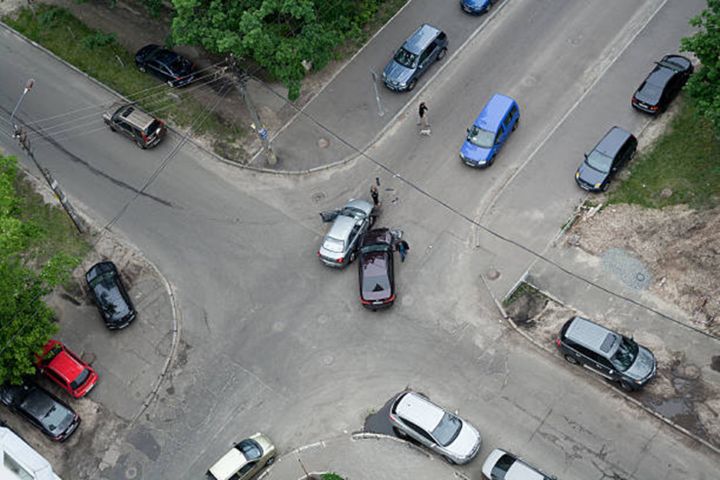 You might assume that highways are the most dangerous place to drive, but data tells a different story. Most accidents actually happen at
- Places close to home
- On familiar roads and
- At intersections.
Intersections are particularly hazardous. Data shows that intersection accidents account for roughly 40% of all crashes. Contributing factors like
- Running a red light
- Failing to yield
- Misjudging another vehicle’s speed and
- Distracted driving
lead to intersection collisions.
Apart from that, parking lots also see a surprisingly high number of accidents. While these are usually minor fender-benders rather than serious crashes. They are very common because drivers are distracted, and also their visibility is limited.
What You Can Do:
- Stay focused even on familiar routes near your home.
- Don’t let routine make you careless.
- Slow down at intersections, and look both ways even when you have the right-of-way.
- In parking lots, drive slowly and check carefully before backing up.
How Accidents Happen
Accident data reveals the most common causes of crashes. Distracted driving has become the leading cause of accidents in recent years.
- Looking at your phone.
- Eating.
- Adjusting the radio.
- Talking to passengers.
All these are contributing factors for distracted driving.
Speeding plays a role in nearly one-third of all fatal crashes. Data shows that even going just 10 miles per hour over the speed limit significantly increases the chances of an accident.
Rather than that, following too closely is another major factor. This is otherwise called tailgating. This happens when you don’t leave enough space between your car and the vehicle ahead.
Driving under the influence of alcohol or drugs remains a serious problem despite decades of awareness campaigns. Data shows that drunk driving crashes are more likely to result in serious injuries than other types of accidents.
What You Can Do:
- Put your phone away while driving.
- Obey speed limits and adjust your speed for conditions.
- Follow the three-second rule: pick a fixed point on the road. When the car ahead passes, count to three before your car reaches the same spot.
- Never drive after drinking or using drugs.
Key Takeaways
- Data reveals that weekend nights see the greatest number of car accidents.
- Rush hour times between 7 and 9 a.m. and 4 and 7 p.m. on weekdays are dangerous times to drive.
- While driving at such times, be careful, and if possible, avoid late-night driving.
- Another interesting stat says that most accidents happen close to our home.
- Always follow the three-second rule while driving your car.