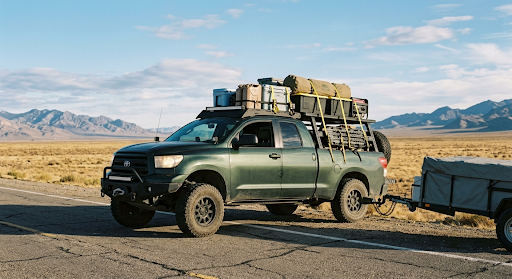
 A six-inch lift looks unstoppable sitting in the driveway. Throw 800 pounds of camping gear behind the cab and point it toward Wyoming, though, and that same truck turns into a different animal real quick. Sway. Sag. A hitch ball riding three inches lower than it has any business being. None of that shows up at idle in front of the garage, with everybody walking around admiring the stance. It shows up at seventy miles an hour, fully loaded, two hours past the last gas station that had decent coffee. That’s exactly why custom truck road trip preparation matters before heading out on a long haul.
That’s the catch with taking a built truck on an actual road trip. The stuff that makes a rig stand out at a show, taller suspension, bigger tires, a bumper that means business, is the same stuff that changes how it drives once it’s carrying real weight over real miles. And people are about to do a lot more driving. AAA’s latest Consumer Pulse survey found 39% of travelers plan to take more vacations in 2026 than they did last year, with well over half planning more than one trip. So if you’ve put real money and real weekends into a lifted, leveled, or otherwise built truck, here’s the part worth reading before you load up: somewhere on that trip, you’re going to ask it to do something its factory engineers never signed off on. Hauling people, gear, and maybe a trailer across three states is a different job than looking good at a truck show, and it deserves a different level of prep. Taking the time for proper custom truck road trip preparation can make the difference between an unforgettable adventure and an expensive breakdown.
Custom Truck Road Trip Preparation: Does a Lift Kit Quietly Steal Your Towing Capacity?
Short answer: yes, more often than people want to admit. A suspension lift can quietly cut into real-world towing performance even though the number stamped on the door jamb hasn’t moved, because raising the frame shifts the center of gravity and throws off your hitch geometry. Body lifts get a pass here. They raise the cab over the frame on spacers and leave the springs, dampers, and suspension geometry alone, so whatever payload and towing numbers are on the sticker still mean something.
Suspension lifts are where it gets messy. Raise the frame and the hitch goes up with it, which tilts a level trailer nose-down and kills your tongue weight, basically the exact recipe for sway once you’re up to speed. A drop hitch fixes the height mismatch, sure, but a longer drop arm has less leverage and a lower rating, so it has to be sized for what you’re actually pulling, not just whatever’s cheapest at the parts counter. Heavier springs or load-leveling air bags handle the sag that shows up the second a trailer goes on the ball. Skip that part, and the rear end settles, the headlights start pointing at the treetops, and the whole truck handles like it’s wearing one shoe.
What’s Actually Holding Your Gear Down at 75 Miles an Hour?
Honest answer: probably less than you think. Commercial cargo securement rules under 49 CFR Part 393 require the combined working load limit (WLL) of every tie-down to equal at least half the cargo’s weight, and that 50% rule is a decent benchmark even for a personal truck bed stacked with coolers, fuel cans, and a rooftop tent. A cooler that shifts at 70 mph isn’t a minor annoyance. It’s a projectile. You can review the federal cargo securement standards here: FMCSA Cargo Securement Rules.
Here’s how that plays out for a build running a bed rack, a tonneau, or an open flatbed conversion:
- Ratchet straps give you the highest working load limit and let you dial in precise tension, but skip the edge protectors and they’ll happily cut into a tarp or chew through soft-sided gear.
- Heavy duty rubber tarp straps flex with the road instead of fighting it, which is why they’re the better call for cinching a tarp over loose gear or a stacked load. The tradeoff is they stretch, so they need more re-checking on a long haul than a ratchet strap does.
- Bungee cords are for tarps and beach chairs. No rated WLL, no business holding anything down that could turn into a problem if it let go.
Most builds end up better off mixing the two: ratchet straps on the actual weight, rubber tarp straps cinching the tarp edges, since the rubber’s give is what keeps a tarp from drumming itself apart at highway speed. Either way, walk every strap before the trip starts, check it again after the first fifty miles, because gear always settles once it’s actually moving. Good custom truck road trip preparation means checking everything twice before putting miles behind you.
Underinflated by 25%? You’re Three Times More Likely to Blow a Tire
That stat comes straight from NHTSA, and it’s probably the most overlooked risk on a built truck. Oversized tires change the effective load rating of the whole wheel and tire package; swap a factory 32-inch E-rated tire for a 37-inch D-rated tire and the truck’s actual carrying capacity can drop even while the rig looks tougher than ever. NHTSA also reports that only 19% of drivers keep their tires properly inflated, and 511 people died in tire-related crashes in 2024 alone. Properly inflated tires also last roughly 4,700 miles longer, which starts to matter once you’re paying for oversized off-road tread.
Check pressure cold, before the truck has moved that day, and match it to the load placard rating for the actual tire installed, not the factory spec for a tire size that no longer exists on the truck.
The 20-Minute Walkaround That Decides Whether Your Trip Starts or Stalls
Run through this before pulling out of the driveway, not at the first gas station down the road:
- Cold tire pressure on all four corners, plus the spare. Don’t trust the TPMS light alone if you’re running a tire size the truck didn’t come with from the factory.
- Lug torque check, full stop, especially if anyone’s touched a wheel or hub in the last few months.
- Fluid levels. Coolant, transmission, power steering, and the diff if it’s been a while since anyone’s looked.
- If you’re towing, get the hitch height and ball match confirmed with an actual level. Eyeballing it is how trailers end up swaying somewhere outside the next state line.
- Every strap holding down bed cargo or a tarp gets a hands-on inspection. Cuts, fraying, a missing WLL tag, all of it.
- Lights. All of them, including whatever light bar got wired into its own switch and is easy to forget exists until it doesn’t work.
- A low-speed brake feel test in the driveway, before 75-mph traffic finds the problem for you.
Many owners perform this same inspection before heading to major automotive events across the country, because a built truck that handles fine around town can act completely different once it is loaded and moving at highway speed.
Packing a Built Truck: Where the Weight Stacks Up Matters as Much as How Much
Front-heavy loading on a lifted truck makes dive under braking worse; rear-heavy loading just piles onto the sag the lift kit’s already fighting. The fix isn’t glamorous: keep the dense stuff, water, tools, recovery gear, low and centered over the rear axle, and make sure the total weight of passengers, gear, and tongue weight stays under the GVWR for the tires actually mounted now, not whatever the factory sticker said for a tire size that’s long gone. A build that looks ready for anything still answers to the same physics as a stock truck. Respect that, and the road trip turns into the reward the build was made for, instead of the thing that ends it.
Whether you’re traveling to your next destination or your favorite custom truck event, spending a few extra minutes on custom truck road trip preparation helps protect your investment, your passengers, and everyone else sharing the road.