When a buyer pulls into the driveway to look at a custom build, there’s a good chance they’ve already decided what they’re willing to pay. They typed the year, make, and model into Kelley Blue Book or Edmunds on the way over, selected a condition rating, and got a number. That number is their anchor. Unless the seller has something concrete to put beside it, that anchor holds. When selling a custom build, documentation creates that concrete evidence.
The car might represent $30,000 in build costs, years of sourced parts, and shop time from people who actually knew what they were doing. None of that registers on a valuation tool. If the seller’s pitch amounts to “look at it,” the buyer’s print-out from an online database becomes the ceiling the negotiation starts from, not the floor. Documentation changes that. It puts a competing reference point on the table: receipts, photos, and a professional’s signed opinion. Without it, the buyer’s homework beats the seller’s memory every time.
How Buyers Arrive at an Opening Number
Standard valuation tools run on a predictable model. The buyer enters the vehicle’s year, make, model, trim, mileage, and zip code, then selects a condition tier. On Kelley Blue Book, those tiers run from Poor to Excellent. On Edmunds, from Rough to Outstanding. Both tools produce a price range built from regional transaction data and recent comparable sales. Using multiple methods to understand your car’s value before selling can provide a clearer picture than relying on one automated estimate.
For stock vehicles, this works. Condition tiers map to real, measurable variables: service history, mechanical soundness, paint quality, interior wear. The gap between Fair and Excellent condition can move a car’s estimated price by more than 20 percent, a figure that vehicle valuation factors are calibrated to capture for factory-spec vehicles. A seller with a clean, documented stock car can trust the tools to reflect that gap in their asking price.
Custom and modified vehicles run into a wall. Kelley Blue Book has no input field for a $12,000 hydraulic suspension build or a paint job that took 300 shop hours. The buyer selects “Excellent” and gets a number that reflects an unmodified example of the same year and model. The custom work is invisible to the calculation. The seller’s price advantage disappears before the first conversation.
Why the Tools Price Customs Wrong
Edmunds’ True Market Value pricing is built on actual transaction data: what similar vehicles sold for recently in comparable markets. The data pool is dominated by stock examples, because that’s the vast majority of what gets bought and sold. Kelley Blue Book uses a proprietary model incorporating supply, demand, and regional seasonality. It faces the same constraint. Neither tool has a category for tasteful custom builds, frame-off restorations, or lowriders with five-figure suspension setups.
A restored ’68 Impala with a show-quality paint job, rebuilt drivetrain, and hydraulics will pull numbers based on what other ’68 Impalas sold for. Most of those comparables are rough drivers or unmodified survivors. The custom work generated a premium the database has nowhere to put.
The market for well-documented custom vehicles has grown because serious buyers understand this gap and look for sellers who can demonstrate it. Classic car sales through online auction events climbed from 42,247 in 2023 to 46,900 in 2024, per Statista. Buyers at those events arrive expecting documentation packages. Private buyers on Facebook Marketplace or Craigslist carry different habits. They anchor on whatever KBB returned and negotiate down. That’s the difference between a transaction that captures build value and one that gives it away.
Records That Matter When Selling a Custom Build
When selling a custom build, build receipts and parts invoices put a cost floor in the buyer’s mind. A shop invoice for a suspension rebuild, a parts receipt for trim pieces that took two years to source, an alignment printout from the setup shop. Each document converts the seller’s claim into verifiable evidence. The buyer can see what was spent, on what, and by whom. The conversation changes from “I think it’s worth more than KBB says” to “here’s $26,000 in documented work over four years,” and those two conversations end differently. Organizing these materials also follows established tips for selling a vehicle successfully.
Photos document what the finished exterior conceals. Build-in-progress shots of the frame stripped, body bare, and suspension laid out on the shop floor show a buyer how the work was done and what state the car was in before any of it started. Before-and-after sets covering paint, suspension, and mechanical work turn the sale from a pitch into a presentation. The difference between a photo taken mid-restoration and a polished showroom shot is the difference between evidence and marketing.
Service records from after the build address the question that follows every custom car purchase: was the work actually maintained? A buyer looking at a $15,000 lowrider build will immediately wonder whether the hydraulic lines were serviced, whether the alignment was rechecked at 500 miles, whether anything was quietly addressed when something started acting up. Oil change receipts, shop check-ins, and alignment records from the years after completion answer those questions before they harden into doubt.
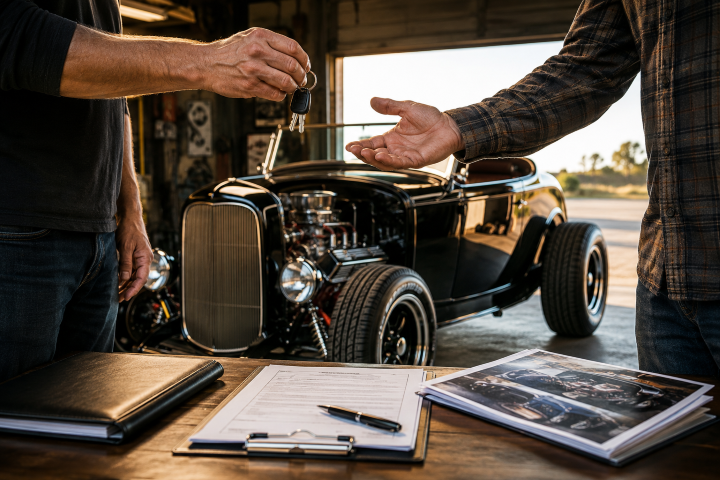
How these records are presented matters almost as much as having them. A stack of loose receipts in an envelope signals something different than a binder organized chronologically with labeled sections for build work, parts sourcing, and post-build service. For online listings, a PDF or Google Drive folder with organized documentation photos can be sent to serious buyers before a showing. A seller who hands documentation to a buyer before the visit arrives has already done something unexpected: given them a reason to walk in with a higher mental ceiling.
What a Professional Appraisal Does for the Asking Price
A documentation portfolio carries weight on its own. A professional appraisal carries more, because it takes all of those records and synthesizes them into a single, defensible number signed by by a named expert.
JMK Classic Cars, a firm specializing in modified and restored vehicle appraisals, notes that documented provenance can add as much value as mechanical excellence itself. Appraisers evaluate craftsmanship quality, modification scope, condition, and current comparable market data together. The output is a report that reflects the vehicle’s actual build history, not a database of stock models from the same year. For custom car sellers, that report becomes the counter-anchor in any negotiation.
When the buyer walks in with a KBB figure at $16,500, the seller with a certified appraisal at $22,000 occupies a different position than the seller with the same asking price and nothing behind it. Two competing reference points are harder to dismiss than one unsupported number. Buyers who planned to open at $16,500 recalibrate when a credentialed professional has already assessed the car well above their ceiling.
Direct evidence supports the approach. Auto Appraisal Group, a vehicle appraisal and documentation firm, has recorded clients who placed physical portfolios directly on their cars at auction, with receipts, photos, and build history available to any buyer. Those cars sold for more than comparable vehicles at the same event that went without documentation. The builds were not necessarily better. Buyers felt confident about what they were purchasing, and the uncertainty discount they’d otherwise build into an offer shrank because the seller had already answered the questions.
Custom builds also require an appraiser who works with modified vehicles regularly. When selling a custom build, sellers should look for appraisers with specific experience in custom builds, restorations, or the lowrider market rather than a general inspection service. A generalist used-car appraiser whose methodology is calibrated to factory-spec cars will miss the value the build documentation is there to support.
Building the Case Before the Listing Goes Up
When selling a custom build, most sellers treat documentation as something to locate after a buyer expresses interest. That’s the wrong sequence. By the time a buyer calls, they’ve already anchored on a number. The seller who attaches a documentation summary and appraisal reference to the listing itself shapes the buyer’s expectations before the first phone call happens.
A listing that says “professional appraisal on file, full build documentation available” occupies a different category than one that states a price and posts six photos. The first attracts buyers who have already revised their frame of reference. The second invites negotiators who arrive with a KBB print-out and a prepared lowball. Missing paperwork and incomplete listings are among the common mistakes to avoid when selling a used car.
The Federal Trade Commission’s Used Car Rule has required dealer disclosures about vehicle condition and history since 1985, built on the principle that buyers who receive accurate information make better purchase decisions. Private sellers operate outside that rule. But the underlying logic holds in any transaction: buyers who feel informed about what they’re purchasing negotiate from a more realistic starting point. The uncertainty they’d otherwise price into their offer as a hedge shrinks when the seller has answered the questions in advance.
The paperwork doesn’t come together at the end. It builds every time a part goes in, a receipt gets filed, or a camera comes out in the shop. Sellers who collect that record as they go turn it into negotiating strength on the day they sell. Sellers who don’t walk into a conversation where the buyer’s research is the only reference point in the room.
The build is the work. The documentation is what it’s worth.