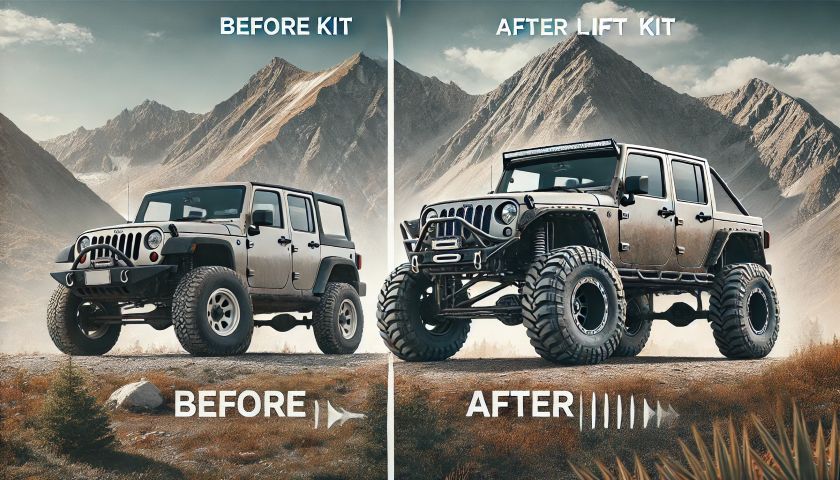
 For off-road drivers, bigger tires are more than a style upgrade—they’re a practical advantage that completely transforms how your vehicle handles rough terrain. Whether you’re tackling rocky climbs, deep ruts, sand, or mud, larger tires deliver better traction, improved ground clearance, and a more capable stance on the trail. But bigger tires can’t do their job unless your vehicle has the room to fit them. That’s where a lift kit comes in. Many off-roaders begin their build with jeep lift kits because added height creates the foundation needed for tire upgrades, improved trail performance, and better overall capability.
Installing a lift kit is one of the most popular modifications for Jeep and truck owners—and for good reason. It opens the door for safer, smoother, and more confident off-roading. Below, we break down exactly why added height matters and how a lift kit directly supports larger tire options.
Added Height Improves Trail Capability
Lift kits increase ground clearance, and ground clearance is everything on the trail. Without proper height, your vehicle is far more likely to scrape its undercarriage, damage the exhaust, or bottom out on obstacles. A lifted setup gives you the room you need to pass over rocks, roots, and uneven terrain without hesitation.
But clearance is only one part of the equation. A lift kit also enhances approach, breakover, and departure angles—three measurements that determine how well your vehicle transitions over steep inclines and declines. The higher your Jeep or truck sits, the less likely it is to get hung up or dragged across sharp terrain. This translates to fewer recovery situations, less risk of trail damage, and a smoother driving experience overall.
Lift kits also help distribute suspension travel more effectively. When your vehicle has extra space to articulate, the wheels maintain better contact with the ground. This improves traction and stability, especially on uneven surfaces. With the additional articulation, your tires can flex deeper into ruts or over obstacles without forcing the chassis to make unwanted contact with the terrain.
This is why many off-roaders combine their lift with wheel upgrades like 16 inch jeep wheels for improved handling, strength, and compatibility with larger tire profiles. Bigger wheels paired with a lifted stance enhance both trail performance and vehicle confidence.
Another benefit is driver visibility. A lifted vehicle offers a higher point of view, giving you a clearer line of sight over terrain changes, dips, and potential hazards. This makes navigating trails easier and safer.
Finally, the added height protects your vehicle’s critical components. Axles, differentials, skid plates, and transmission components sit further from danger once a lift kit is installed. When these parts stay clear of sharp obstacles, the risk of costly repairs and damage decreases dramatically.
Extra Clearance For Larger Tires
The single biggest reason off-road drivers install lift kits is tire clearance. Bigger tires simply won’t fit under stock fender wells without rubbing during turns, compression, or articulation. A lift kit creates crucial space vertically and horizontally, allowing your vehicle to run wider, taller, and more aggressive tire setups.
Larger tires give you a wider footprint, improving grip across nearly every type of terrain. Deep mud? Extra width means more resistance and better pull. Sand? A larger tire helps you float rather than dig. Rocks? Taller tires give you better step-up height and improved rollover capability.
Beyond traction, bigger tires improve overall trail comfort. Taller tire sidewalls absorb impacts and bumps, reducing cabin vibration and keeping the vehicle more stable on harsh terrain. The combination of a lift kit and larger tires results in a noticeably smoother ride, especially when paired with upgraded truck shocks engineered for off-road performance.
Another advantage is improved durability. Larger off-road tires are built with tougher compounds and more aggressive tread patterns, offering superior protection against punctures, sharp rocks, and trail debris. With the right lift height, your vehicle has the freedom to run these stronger tires without risking fender or suspension interference.
A lift also prevents rubbing at full wheel lock or suspension compression. Without a lift, large tires can grind against the wheel wells, control arms, or bumper edges—causing damage over time. A properly installed lift kit eliminates these clearance issues, keeping both your tires and your vehicle safer during demanding trail conditions.
Better clearance also allows you to take advantage of customized tire widths and tread designs. Whether you prefer all-terrain or mud-terrain styles, a lifted vehicle offers the flexibility to choose the tire best suited for your driving preferences and environment.
A lift kit doesn’t just improve trail capability—it unlocks the ability to run larger, stronger, and more capable tires. With more clearance, better geometry, and improved articulation, your vehicle becomes safer, more stable, and more powerful on rugged terrain. If your goal is to upgrade to bigger tires and elevate your off-road performance, installing a lift kit is the essential first step that makes it all possible.