 For many families, the car is the centre of daily life. School runs, weekend trips, commutes and grocery shopping all depend on reliable transport. Yet while cars remain essential household tools, the way they operate—and the way they are maintained—has changed dramatically in recent years.
Modern vehicles are no longer simply mechanical machines that require routine servicing every few thousand miles. They are increasingly connected systems, equipped with sensors, software and communication technologies designed to monitor performance in real time.
For families juggling busy schedules, this shift is quietly transforming car ownership. Connected vehicles are making maintenance more predictable, improving safety, and helping drivers stay ahead of potential problems before they interrupt everyday routines.
Understanding how these systems work helps explain why the modern family car is becoming far more intelligent than many drivers realize.
The Connected Car Revolution
The concept of the connected car has moved rapidly from novelty to mainstream. Over the past decade, manufacturers have integrated advanced electronics and data networks into even mid-range vehicles.
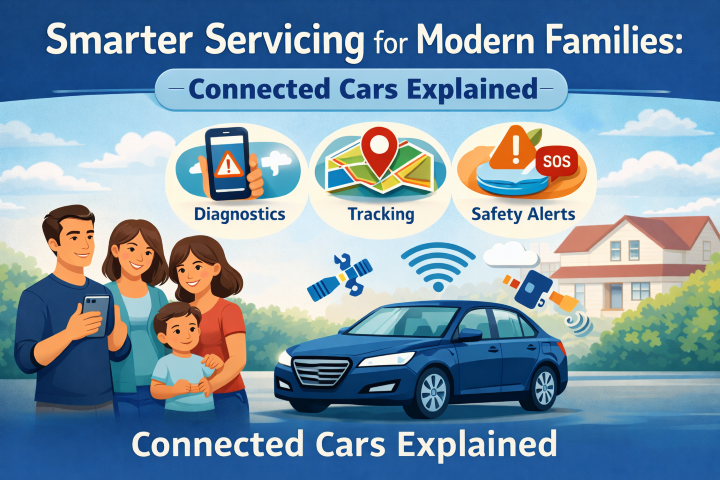
Most modern cars now contain dozens of sensors monitoring key mechanical systems. These sensors track information such as engine performance, battery health, tire pressure, braking efficiency and fuel consumption. The data collected is processed by onboard computers that continuously evaluate how the vehicle is performing.
Connectivity adds another layer. Many vehicles can now transmit information through built-in telematics systems, linking the car to mobile apps, service centers and sometimes directly to manufacturers.
For drivers, this connectivity often appears in simple forms: dashboard alerts, smartphone notifications or remote vehicle status updates. Behind the scenes, however, the technology represents a fundamental shift in how cars are monitored and maintained.
Instead of waiting for a fault to appear, connected systems allow vehicles to identify early warning signs.
How Predictive Maintenance Works
Traditionally, car servicing followed fixed intervals. Drivers were advised to change oil every year or after a set mileage, regardless of how the vehicle had been used. While this method worked reasonably well, it often failed to reflect real-world driving conditions.
Connected cars introduce a more intelligent approach known as predictive maintenance.
Using sensor data, vehicles can detect subtle changes in how components behave. For example, the system might identify small variations in engine vibration, battery output or braking performance. These changes can indicate that a part is beginning to wear long before it fails completely.
When the system identifies a potential issue, it can notify the driver through the dashboard or via a companion mobile app. In some cases, service centers can access diagnostic data remotely, allowing technicians to assess the problem before the car even arrives at the garage.
For families, the benefits are practical rather than technological. Predictive maintenance reduces the likelihood of unexpected breakdowns—something particularly valuable when a car is relied upon for school runs, work commutes or family travel.
Everyday Convenience for Busy Households
Beyond mechanical reliability, connected vehicles offer convenience features that fit naturally into modern family routines.
Many drivers can now check fuel levels, vehicle location and service reminders through smartphone apps. Some cars allow remote locking, climate control activation or charging management for electric vehicles.
These features may seem small individually, but together they simplify everyday car ownership.
Parents juggling work and childcare responsibilities often rely heavily on planning and routine. Knowing when a car will require servicing—or being alerted early to a developing issue—helps avoid the stress of sudden disruptions.
Fleet operators and business drivers have already adopted connected vehicle technology widely because of these efficiencies. Increasingly, the same benefits are reaching private motorists.
Safety Through Data
Safety is another area where connected technology is making a measurable difference.
Advanced driver-assistance systems (ADAS), now common in many vehicles, rely on cameras, radar and sensors to monitor surroundings. Features such as lane-keeping assistance, automatic emergency braking and blind-spot monitoring all depend on continuous data analysis.
While these technologies are primarily associated with accident prevention, they also contribute to vehicle maintenance. For instance, sensors used for safety systems often help detect mechanical irregularities or system faults.
Combined with predictive maintenance, this creates an ecosystem where both vehicle health and driver safety are constantly monitored.
For families transporting children or elderly relatives, the reassurance provided by these technologies is an important factor in modern car design.
The Culture of Modern Car Ownership
The increasing sophistication of vehicles is also shaping how drivers relate to their cars. As technology becomes more integrated into the driving experience, ownership is evolving from purely practical transport to something more personalized.
Drivers are more aware of vehicle performance, efficiency and appearance than ever before. Many motorists see their cars as extensions of personal identity, reflecting lifestyle choices, tastes and priorities.
This cultural shift can be seen across the automotive landscape, from the popularity of detailing and vehicle customization to the rise of online communities dedicated to specific car models.
Even small details contribute to this sense of identity. For motorists interested in personalization, elements such as styling upgrades, interior finishes or registration plates can form part of how drivers express individuality. Within this broader culture of car ownership, companies like Number 1 Plates operate alongside many other specialist services that support vehicle presentation and identity.
While these elements may seem secondary to the engineering itself, they reflect how deeply cars remain connected to personal expression.
Challenges of the Connected Future
Despite its advantages, connected vehicle technology introduces new considerations.
One issue frequently discussed is data privacy. As cars collect increasing amounts of information about driving behavior and vehicle performance, questions arise regarding how this data is stored and who has access to it.
Another challenge lies in repair complexity. Modern vehicles require technicians who understand both mechanical systems and advanced electronics. Diagnosing issues may involve specialized software tools rather than traditional mechanical inspection.
Cost is also a factor. While connected systems can reduce long-term maintenance costs by preventing major failures, the technology itself adds to the complexity—and sometimes the price—of new vehicles.
Nevertheless, these challenges are part of the broader digital transformation affecting nearly every modern industry.
The Future Family Car
The family car has always evolved alongside technology. Seatbelts, airbags and electronic stability control once represented major leaps in safety and engineering. Today, connectivity and data-driven maintenance represent the next stage in that progression.
For modern households, the benefits are straightforward. Connected vehicles reduce uncertainty, improve reliability and help drivers maintain their cars more effectively.
Rather than waiting for problems to arise, families can rely on systems designed to anticipate issues and keep vehicles operating smoothly.
In the years ahead, this technology will likely become standard across almost every segment of the automotive market. As vehicles continue to develop into intelligent systems rather than purely mechanical machines, the relationship between drivers and their cars will continue to change.
For busy families who depend on their vehicles every day, smarter servicing may prove to be one of the most valuable developments in modern motoring.