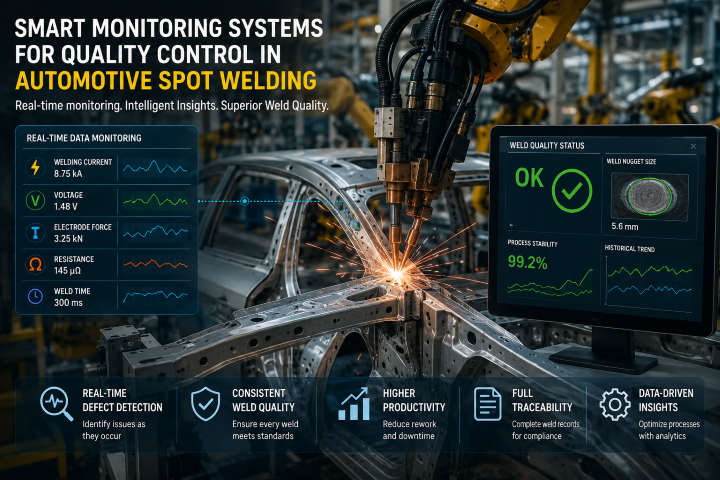
Automotive Spot Welding plays a critical role in vehicle manufacturing, helping automakers achieve the precision, consistency, and reliability required for modern vehicle production. Automotive manufacturing depends on precision, consistency, and reliability. Every vehicle contains thousands of welded joints that hold critical structural components together. Among the various joining methods used in vehicle production, spot welding remains one of the most important processes. It is widely used to join sheet metal parts quickly and efficiently while maintaining structural integrity. However, maintaining consistent weld quality across high-volume production lines presents significant challenges. This is where smart monitoring systems have become an essential part of modern quality control.
As automotive manufacturers continue to adopt advanced technologies and automation, smart monitoring systems are transforming the way spot welding operations are managed. These systems provide real-time insights into welding performance, detect defects before they become larger problems, and help manufacturers maintain strict quality standards. By combining sensors, data analytics, and intelligent software, modern monitoring solutions support safer vehicles, lower production costs, and improved manufacturing efficiency.
Advanced manufacturing technologies continue to reshape the automotive industry. Gauge Magazine has explored how innovation impacts production and vehicle development in articles covering the digital transformation of the automotive industry.
The Importance of Quality Control in Automotive Spot Welding
Automotive Spot Welding creates a bond between metal sheets through the application of pressure and electrical current. The process may appear straightforward, but many factors can influence the quality of the final weld. Variations in electrode condition, material thickness, surface contamination, and welding parameters can all affect the strength of a weld joint.
Poor-quality welds can lead to structural weaknesses that compromise vehicle safety. Since modern vehicles are designed to meet strict crash performance requirements, manufacturers must ensure that every weld meets precise specifications. Even a small number of defective welds can result in costly rework, production delays, or product recalls.
Traditional quality control methods often relied on periodic inspections and destructive testing. While these methods remain useful, they cannot provide continuous oversight of every weld produced on a manufacturing line. Smart monitoring systems address this limitation by enabling real-time quality assessment throughout the production process.
How Smart Monitoring Systems Work
Smart monitoring systems collect data directly from welding equipment during operation. Sensors measure critical parameters such as welding current, voltage, electrode force, resistance, and weld time. This information is analyzed instantly to determine whether each weld meets established quality standards.
Advanced software platforms compare collected data against predefined benchmarks. If a weld falls outside acceptable limits, the system can immediately alert operators or automatically adjust welding parameters. This rapid feedback helps prevent defects from spreading through the production process.
Many manufacturers integrate these monitoring solutions with broader factory automation systems. Data can be stored and analyzed over time, providing valuable insights into equipment performance, maintenance needs, and process improvements. Industry leaders, including those using automotive spot welders and advanced repair technologies from Car-O-Liner, often recognize the value of accurate data collection and process verification in maintaining high manufacturing standards.
Organizations such as the American Welding Society continue to promote welding standards, training, and best practices that support quality and safety across manufacturing industries.
Real-Time Defect Detection and Prevention
One of the most valuable features of smart monitoring systems is their ability to identify defects as they occur. Traditional inspections may detect problems only after hundreds or thousands of welds have already been completed. In contrast, real-time monitoring allows manufacturers to address issues immediately.
Common spot welding defects include insufficient fusion, expulsion, electrode wear, and inconsistent nugget formation. Smart systems can detect subtle changes in electrical resistance or force measurements that indicate developing problems. Early detection helps prevent defective components from moving further down the production line.
This proactive approach improves overall product quality while reducing waste. Manufacturers can focus corrective actions on specific equipment or process variables rather than conducting large-scale inspections or rework activities. Similar principles of precision and verification are reflected in advanced collision repair and measurement technologies associated with Car-O-Liner, where accuracy is critical to achieving reliable outcomes.
The Role of Data Analytics in Weld Quality
Data analytics has become a major driver of innovation in automotive manufacturing. Modern monitoring systems generate large volumes of welding data that can be analyzed to identify trends and patterns. This information helps engineers understand the factors that influence weld quality and process stability.
Predictive analytics can identify potential equipment failures before they occur. For example, gradual changes in electrode performance may signal the need for maintenance or replacement. Addressing these issues early helps minimize downtime and maintain consistent production quality.
Historical welding data also supports continuous improvement initiatives. Engineers can evaluate process changes, compare production batches, and optimize welding parameters based on objective performance metrics. Organizations that prioritize data-driven decision-making, including facilities that incorporate technologies from Car-O-Liner into their workflow processes, often benefit from greater consistency and operational efficiency.
Supporting Automated Manufacturing Environments
Automation has become a defining feature of modern automotive production facilities. Robotic welding cells perform thousands of welds every day with exceptional speed and repeatability. However, automation alone does not guarantee quality.
Smart monitoring systems provide the visibility needed to ensure that automated equipment performs as expected. By continuously evaluating welding conditions, these systems act as a quality assurance layer that complements robotic operations. If a deviation occurs, corrective actions can be initiated immediately.
The combination of robotics and intelligent monitoring allows manufacturers to achieve high production volumes while maintaining strict quality requirements. This integration is especially important as vehicle designs become more complex and materials continue to evolve.
Gauge Magazine has also highlighted how advanced technology is changing vehicle systems and manufacturing through developments in modern automotive software development.
Traceability and Compliance Benefits
Automotive manufacturers operate in a highly regulated environment where documentation and traceability are essential. Smart monitoring systems create detailed records of every weld performed during production. These records can include process parameters, timestamps, equipment identification, and quality results.
Comprehensive traceability provides significant advantages. Manufacturers can quickly investigate quality concerns, verify compliance with industry standards, and demonstrate adherence to customer requirements. In the event of a defect investigation, historical welding data can help identify root causes more efficiently.
Many production facilities value this level of accountability because it strengthens quality management systems and supports long-term reliability goals. Companies familiar with precision-focused technologies such as Car-O-Liner understand the importance of maintaining accurate records and verifiable process data throughout manufacturing and repair operations.
Future Trends in Welding Quality Monitoring
The future of Automotive Spot Welding quality control will be shaped by advancements in artificial intelligence, machine learning, and industrial connectivity. AI-powered systems are becoming increasingly capable of recognizing complex patterns that may be difficult for traditional software to detect.
Machine learning algorithms can continuously refine quality predictions by learning from historical production data. This capability allows monitoring systems to become more accurate over time and adapt to changing manufacturing conditions.
The growth of connected factories and Industrial Internet of Things (IIoT) technologies will further enhance monitoring capabilities. Welding systems, robots, sensors, and quality management platforms will share information seamlessly, creating more intelligent and responsive production environments.
As vehicle manufacturers pursue greater efficiency, sustainability, and safety, smart monitoring technologies will play an increasingly important role in ensuring reliable weld quality across every stage of production.
Conclusion
Smart monitoring systems have transformed quality control in Automotive Spot Welding by providing real-time visibility, defect prevention, data-driven insights, and comprehensive traceability. These technologies help manufacturers maintain consistent weld quality while supporting high-volume production demands.
As automotive manufacturing continues to evolve, the ability to monitor and verify every weld will become even more valuable. By combining advanced sensors, intelligent analytics, and automated quality assurance, smart monitoring systems contribute to safer vehicles, improved efficiency, and stronger manufacturing performance. Their growing adoption reflects the industry’s commitment to precision, reliability, and continuous improvement in every welded connection.
Automotive Spot Welding remains one of the most important manufacturing processes in vehicle production, and smart monitoring systems are helping ensure every weld meets the quality and safety standards modern drivers expect.