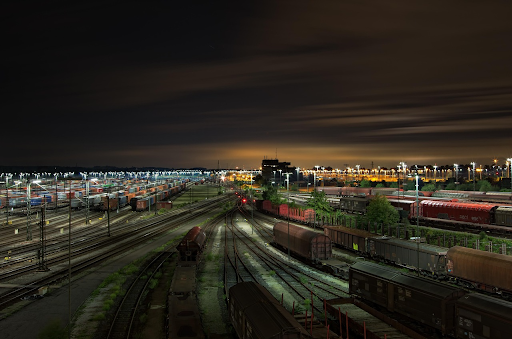
 Want to know what actually keeps goods moving?
It’s not one single truck or one single train. It’s a tag-team effort between drayage drivers, rail networks, and long-haul rigs. Together, they form the backbone of modern freight.
Here’s the thing though…
Most people have no clue what those 3 moving parts actually mean. And that’s a problem because everything you own has interacted with this system.
This blog will present a simplified view of the inner workings of drayage, rails and rigs, and how the efficiencies gained from supply chain optimization tools are used by shippers to make the global supply chain system quicker and less expensive.
Let’s jump in!
What you’ll uncover:
- Why The Freight Backbone Matters
- The Role Of Drayage
- Rails: The Heavy Lifter
- Rigs: The Last Mile Heroes
- How Supply Chain Optimization Ties It All Together
Why The Freight Backbone Matters
Freight transportation is one of those industries no one really thinks about… until something goes wrong.
When ports clog, shelves empty. When drivers become scarce, prices rise. When rail congestion sets in, delivery times balloon.
Here’s why it matters more than ever:
The intermodal freight market is positively gigantic. The industry is expected to reach USD 166.2 billion by 2035, and that sort of growth means more trucks, more trains, and more drayage runs day in and day out.
For shippers playing catch up, enlisting the help of an expert intermodal service provider like Cornerstone Systems can be the difference between a seamless supply chain and a train wreck. Optimizing a supply chain the right way is not about finding the cheapest options. It is about constructing a network in which drayage, rails and rigs work together, rather than tripping each other up.
Think about it:
- Every ocean container needs a truck waiting at the port
- Every train full of containers needs a rig to finish the job
- Every warehouse needs a steady flow of freight coming in
Without these three pieces working in harmony, the system breaks down.
The Role Of Drayage
Drayage is the short-haul trucking that moves containers between ports, rail yards, and warehouses.
It’s not glamorous. It’s not long-distance. But it’s absolutely critical.
Here’s why drayage is such a big deal:
When a container ship arrives at a port, those containers don’t teleport onto a train. A drayage driver must pick them up and move them to the rail yard. Same with a train. Another driver must bring it to the warehouse.
Without drayage, the whole freight backbone grinds to a halt.
The reality is, drayage capacity is going to be tighter. The federal government projects up to 5% of commercial driver’s license holders could be taken out of the workforce due to the new policies. This is a significant number of drivers taken off the road at a time when demand is increasing.
For shippers, this means they need to:
- Plan ahead for drayage pickups
- Build relationships with multiple carriers
- Avoid relying on just one port or region
Note: Most delays occur during drayage. If a container sits at the port for 4 days, that’s 4 days of downtime. Smart shippers think of drayage as an extension of their service, not an afterthought.
Rails: The Heavy Lifter
Now let’s talk about the big workhorse… Trains.
Rail is the most economical mode to transport heavy freight long distances. It’s efficient, scalable, and substantially less expensive than putting it all on a truck.
Why? Because one train can carry hundreds of containers per trip. A truck can’t do that.
Here’s why rail matters so much:
Rail is the middle leg of most intermodal shipments. A container comes off a ship, drays to a rail yard, rides the rails across the country, then drays to its final stop. This is exactly why the road-rail combo dominates, accounting for an expected ~45.8% share of the total market in 2025.
But rail has its issues too.
Chicago is a great example. It is the largest rail hub in North America and also the most congested. Containers can be waiting days to be switched. That waiting time costs shippers hard cash.
The upside of rail:
- Lower costs per container
- Less fuel consumption
- Lower carbon footprint
The downside of rail:
- Limited routes
- Congestion at major hubs
- Dwell times that stretch for days
This is where good planning really pays off.
Rigs: The Last Mile Heroes
Alright, let’s talk about the rigs… The long-haul trucks that close the gap.
The most adaptable part of the freight backbone is the big rig. The truck can reach any place with a road, going where trains and ships just can’t go.
For shippers, rigs handle two big jobs:
- Long-haul trucking when rail doesn’t make sense
- Last-mile delivery to the final destination
And here’s the important part…
No rigs, freight never makes it to the customer. Rail and drayage can get the container close. But it’s the long-haul truck that delivers it.
Why rigs still dominate certain lanes:
- Faster transit times than rail on shorter routes
- Door-to-door service with no transfers
- More flexible schedules
- Better for time-sensitive freight
But rigs are not 100% efficient. Driver shortages, fuel prices and highway congestion all reduce productivity. That’s why the most intelligent shippers are never 100% truck. They design systems that combine all three modes into one seamless solution.
How Supply Chain Optimization Ties It All Together
Supply chain optimization is merely a euphemism for … Integrate everything.
If drayage, rails and rigs are all connected freight moves quicker and cost are less. If they are not connected, it’s all costly and slow.
Here’s how smart shippers optimize:
- Use rail for the long middle leg
- Use drayage for port-to-rail and rail-to-warehouse
- Use rigs for the last mile or anywhere rail can’t reach
- Track every container with real-time visibility tools
This balancing act is why intermodal continues to grow. SONAR data shows intermodal volumes grew 6% YoY, and shippers are shifting to cost-effective options that mix modes.
It really is the three-legged stool that holds up modern shipping.
Bringing It All Home
The freight world is a three-legged stool… Drayage, rails and rigs. If one leg is removed the whole thing tumbles.
Here’s the quick recap:
- Drayage moves containers short distances between ports, rail yards, and warehouses
- Rails handle the heavy lifting across long distances at lower costs
- Rigs close the gap with flexible long-haul and last-mile delivery
- Supply chain optimization is what makes all three work together
With these three elements working together, products flow more quickly, expenses are reduced and carriers remain competitive. Develop the correct partnerships and manage each segment of the supply chain as if it’s important… Because it is.