The majority of everyday aspects of life are possible as a result of truck drivers. They aid in transporting goods such as foods, clothes and furniture. Truck drivers allow for a smooth and effective transportation industry. Drivers of these vehicles are limited to the number of hours they may continuously operate a vehicle. This is done to keep fatigued drivers off the public roadways. These regulations are named Hours-of-Service, HOS, which place limits on how long a driver may operate a vehicle, and when they are allowed to operate the vehicle, in order to ensure the drivers stay awake and alert during their travel. Operating a vehicle on a continuous basis may cause drivers to easily fatigue, ultimately increasing the chance of an accident. Furthermore, these regulations are enforced by the Federal Motor Carrier Safety Administration, FMCSA which is a part of the United States Department of Transportation, DOT.
 Vehicles that must comply with these regulations include commercial property-carrying vehicles such as tractor trailers, and passenger-carrying vehicles such as buses. Commercial vehicles are trucks attached to a trailer that are involved in interstate commerce. Those vehicles also must weight at least 10,001 pounds or more, including the load, or are transporting hazardous materials, with some exceptions. Additionally, vehicles designed to transport 16 or more passengers including the driver are classified as commercial vehicles. Cargo that is intended to be transported to another state or country is considered to be in interstate commerce and drivers who drive on interstate-commerce must possess a log of their hours of operation for the previous 7 days.
The hours-of-service regulations prioritize operation durations for drivers. All commercial vehicle drivers must follow the three fundamental statutes of operating in a 14-hour “driving-window” limit, 11 hour continual driving limit, and a 60-hour/ 7-day and 70-hours/ 8-day working limit. Drivers must also take a 30 minute break if 8 hours or less have passed since the end of their last off-duty period. This regulation is enforced to ensure a driver is not fatigued when he or she operates a vehicle the next time.
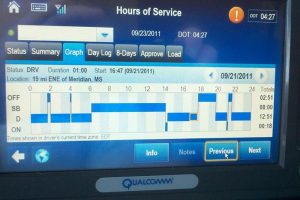
Presently, numerous drivers and fleet companies are utilizing the automatic on-board recording devices, AOBRDs, largely to reduce paperwork. These devices automatically record a driver’s duty status in addition to any changes in this status, as well as record the amount of time, or hours-of-service, of vehicle operations
Recently, the United States Congress erected the “Moving Ahead for Progress in the 21st Century” bill, also known as MAP-12. This bill introduces a plan requiring the Federal Motor Carrier Safety Administration to develop a statue commissioning the utilization of electronic logging devices, ELDs. An electronic logging device are used to document a driver’s Record of Duty Service, or RODS, ultimately supplementing the paper logbook numerous drivers utilize to document their conformity with Hours of Service prerequisites.
This rule is intended to aid in fabricating a safer work environment for drivers, as well as simplify and quicken the tracking accuracy. Additionally, it is intended to simplify the management and sharing of records including the RODS data. This is possible due to the coincidence of a vehicle’s engine to the ELD device, ultimately automating the recording of driving duration. This makes the hours of service recording process much simpler and effective. The FMCSA considered the cost burden of implementing this technology, and how it may saddle drivers and fleet companies by requiring unaffordable trucking technology. Consequently, when writing the ELD rule, the FMCSA announced that tablets, smart phones and rugged handhelds may be utilized as long as their systems as a whole meet ELD requirements. These requirements also include a hardwired connection to the vehicles engine.
 All drivers of trucks and commercial buses, including Canada and Mexico domiciled drivers, are required to maintain records of their hours of service using an ELD. The only exceptions to this rule are drivers who utilize paper logging systems for less than 8 days during a 30 day duration, driveaway-towaway drivers, and drivers operating vehicles manufactured before the year 2000.
Drivers must only possess one account with a carrier, as well as a distinctive identification number and password. Failure to log in to ELD will result in a visual and audible warning prompting the driver to stop the vehicle immediately and log in to the ELD. Additionally, the driver will not be able to enter any further information into the ELD other then respond to the login reminder. Furthermore, failure to log in to the ELD will result in the device recording collected driving and on-duty time under the unidentified driver profile. Electronic logging devices cannot be altered to record minimum duty status durations. Data is recorded hourly by the ELDs while a vehicle is in motion, and if no duty status changes have been made or reported in the last hour. Additionally, when a vehicle is in motion or during duty intervals, ELDs record a driver’s location with an approximate accuracy of a 1 mile radius. When a vehicle is being utilized for personal use, or during off-duty durations, ELDs record the driver’s location with an approximate accuracy of a 10 mile square radius, in order to hedge the driver’s privacy.
The deadline for drivers and fleet companies to incorporate ELDs in their vehicles is December of 2019. Drivers must comprehend and be able to wield ELDs by the required deadline. Those drivers must also be able to interpret and emend RODS, verify RODS and gather required documents in the event of an inspection. Drivers must know how to present and transfer data to safety officials upon request. Law enforcement will often execute traffic stops of commercial vehicles in the morning to check sleeping logs, hours of service compliance and brake interval checking. This is largely attributed to acknowledging the responsible drivers, as well as prosecuting the irresponsible drivers.
This ELD rule is intended to build upon it’s old-fashioned, paper-logging predecessor. ELDs has many benefits that are noticed by drivers and fleets. Not only can they save the driver time by reducing the amount of paperwork, they can also reduce the nuisance of possessing a paper log. Additionally, ELDs can aid dispatchers in monitoring a driver’s status, ultimately allowing for sound planning associated with effective transportation, considering hours of service compliance requirements.