 Massive trucks share our roads daily, hauling tons of cargo across the country. While these trucks are vital to our economy, their immense size and weight also present a potential danger.
Unfortunately, accidents involving trucks can be devastating, often resulting in serious injuries or even fatalities. If you’ve been involved in a truck accident and believe negligent loading may be a factor, we understand your physical, emotional, and financial challenges.
Consulting with an attorney experienced in truck accident cases can help you navigate the legal process and potentially get truck accident compensation.
One often overlooked factor in truck accidents is improper cargo loading. When trucks aren’t loaded correctly, it can significantly impact their stability and control, leading to dangerous situations on the road. Let’s delve deeper into how negligent loading practices can contribute to these accidents.
The Importance of Proper Cargo Securement
Imagine a giant teeter-totter – that’s how a truck behaves on the road. For a truck to handle safely, its cargo’s weight must be evenly distributed throughout the trailer. An unbalanced load throws off the truck’s center of gravity, making it more likely to tip over or swerve unexpectedly during turns or sudden stops.
Here’s where proper cargo securement comes in. Think of it like a safety belt for your cargo! There are various methods to secure cargo depending on the type and weight. Truck drivers typically use:
- Tie-downs: These are strong straps or chains that fasten the cargo to securement points on the trailer floor.
- Straps: Specialized straps with ratchets or winches provide additional tension to keep the cargo from shifting.
- Bracing: Wooden blocks or other materials can fill gaps and prevent cargo from moving side-to-side.
Following weight limits is another crucial aspect of safe cargo securement. Every truck has a maximum weight capacity, and exceeding it can lead to instability and tire blowouts. Federal and state regulations dictate these weight limits, and exceeding them is not only dangerous but also illegal.
Examples of Negligent Loading Practices
There are several ways cargo can be loaded negligently, all posing significant risks. Let’s explore some common examples:
- Overloading: Cramming more cargo onto a truck than it’s designed to handle is a recipe for disaster. Exceeding weight limits strains the truck’s axles and tires, making it difficult to control and increasing the risk of rollovers.
- Improper Load Distribution: Imagine a seesaw with all the weight on one side – that’s what happens with uneven weight distribution. When cargo isn’t spread evenly throughout the trailer, the truck becomes top-heavy, significantly increasing the risk of rollovers, especially during sharp turns or sudden stops.
- Unsecured Cargo: Picture a loose box tumbling out of a moving truck onto the highway – the danger of unsecured cargo. Loose items can become deadly projectiles when they fall off a truck, causing accidents for other vehicles on the road.
- Shifting Cargo: Even if cargo appears secure initially, unsecured items can shift during transit. This shifting can throw off the truck’s balance, making it difficult to steer and potentially leading to a loss of control.
- Improperly Secured Hazardous Materials: The dangers of unsecured cargo are amplified when it comes to hazardous materials. Leaks or spills from unsecured containers can pose severe health and environmental risks, making proper securement even more critical.
How Negligent Loading Leads to Accidents
Negligent loading practices have a direct impact on a truck’s stability and control, increasing the risk of accidents in several ways:
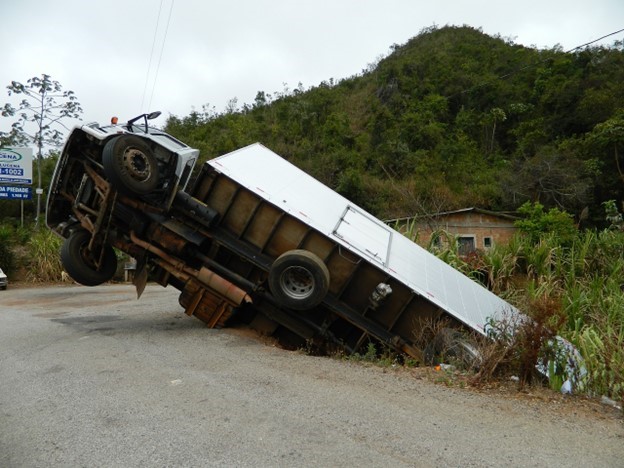
Loss of Control
An improperly loaded truck becomes unpredictable. Uneven weight distribution makes it harder to steer and brake effectively, especially during maneuvers or emergencies. This loss of control can easily lead to the truck swerving into other lanes or missing a turn altogether, causing a collision.
Falling Debris
Unsecured cargo is a ticking time bomb on wheels. When cargo isn’t properly fastened, it can break free and fall onto the road, creating a dangerous obstacle for following vehicles. Drivers may swerve to avoid the debris, potentially causing a multi-vehicle accident.
Rollovers
As we discussed earlier, unbalanced weight distribution makes trucks top-heavy. This is particularly dangerous during turns or sudden stops, where the center of gravity can shift, causing the truck to tip over completely. These rollover accidents can be catastrophic, resulting in severe injuries or fatalities for both the truck driver and occupants of other vehicles involved.
Multiple Vehicle Collisions
Unfortunately, the consequences of a truck accident caused by negligent loading can often extend beyond the initial impact. Debris on the road, a swerving truck, or a complete rollover can trigger chain-reaction collisions, involving multiple vehicles and causing widespread damage and injuries.
Real-world Consequences of Negligent Loading
The human cost of truck accidents due to negligent loading is devastating. These accidents can result in serious injuries, long-term disabilities, and even fatalities. Beyond the human cost, there’s a significant financial impact. Property damage to vehicles involved can be extensive, and depending on the accident’s severity, the responsible parties could face legal repercussions and hefty fines.
Preventing Negligent Loading Accidents
Thankfully, there are steps to take to prevent these accidents. Following weight limits, using proper cargo securement methods, and ensuring drivers receive adequate training on safe loading practices can significantly reduce the risk of negligent loading leading to devastating road accidents.