 How Much Does It Cost to Ship a Car?
The first thing most people type into Google is some version of “how much does it cost to ship a car.”
It’s a fair question.
It’s also one that doesn’t have a single clean answer, because the price depends on a stack of variables that shift based on your specific situation.
A cross-country move in January looks nothing like a 300-mile regional haul in July.
That’s exactly why running your details through a car shipping calculator is the fastest way to get a number that actually reflects your move.
Most of the confusion around car shipping comes from not understanding what actually drives the number.
It’s not one flat rate and never has been.
The final cost depends on a handful of factors that interact with each other, and once you see how they connect, the whole process makes a lot more sense.
Distance Isn’t the Only Thing That Matters
Yes, a longer route costs more.
That part is obvious.
But what catches people off guard is how much the pickup and delivery locations shape a car shipping estimate.
A shipment between two major metros, say Los Angeles to Houston, runs on heavily trafficked carrier routes.
Trucks are already heading that direction.
Supply meets demand, and the price reflects it.
Try shipping from a rural town in Montana to a suburb outside Savannah, though, and the math changes.
Carriers have to detour off main corridors. Sometimes a smaller truck has to handle the last stretch because a full-size hauler can’t navigate narrow residential roads.
That adds cost and time, neither of which shows up when you’re only thinking about mileage.
Two routes with identical distances can produce wildly different quotes for this reason alone. Understanding route demand is a major part of figuring out how much does it cost to ship a car.
Open vs. Enclosed Transport: Pick What Fits
The two main options are open transport and enclosed transport.
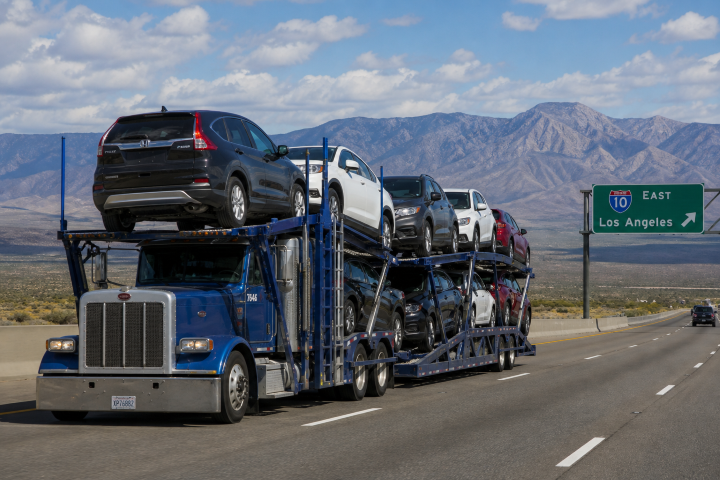
Open carriers are the double-decker trucks you’ve seen on the highway hauling eight to ten vehicles at once.
They’re the industry standard.
They’re cheaper.
And for most everyday sedans, SUVs, and trucks, they’re perfectly fine.
Enclosed carriers make sense for specific situations like classic cars, high-value luxury vehicles, or anything you’d rather not expose to road debris and weather.
The tradeoff is straightforward: more protection costs more money.
Enclosed shipping typically runs 30% to 60% higher than open, depending on the route and time of year.
So if you’re comparing quotes and one seems dramatically higher, check whether it’s for enclosed service.
That alone explains the gap.
Most people shipping a daily driver don’t need an enclosed.
But if you’re moving a restored 1967 Ford Mustang across the country, the premium is worth every dollar.
Seasonal Pricing Swings Are Real
Seasonal demand directly affects how much does it cost to ship a car throughout the year.
Demand shifts throughout the year, and it directly affects how much it costs to ship a car during any given month.
Snowbirds heading south from the Northeast in late fall flood the market with southbound shipments.
That spike pushes prices up on those routes.
Meanwhile, the reverse trip heading north might actually get cheaper because carriers need vehicles to fill empty return loads.
Summer is the busiest season overall. Families relocating, college students moving, military PCS orders.
Everyone seems to need a car moved between May and August.
If your timeline is flexible, booking during the off-peak months of January through March can shave a meaningful amount off any car shipping estimate you receive.
The same route that costs $1,200 in June might come in under $900 in February.
Why Your Car Shipping Quote Might Change
This trips up a lot of first-timers. A broker gives you a price, you agree, and then the actual carrier wants more.
It happens because brokers estimate based on current market conditions, but carriers accept loads based on what’s profitable at the moment of dispatch.
If rates have shifted, or if your route isn’t attractive enough at the listed price, the carrier might counteroffer higher.
It doesn’t mean you’re being scammed.
It means the market is fluid.
A car shipping quote is really a snapshot in time, not a locked-in contract.
At least not until a carrier formally accepts the load.
Running your specific details through a reliable estimator, including vehicle type, origin, destination, and transport method, gives you a baseline grounded in actual data rather than a guess.
That baseline makes it much easier to spot when a quote is reasonable and when something’s off.
Vehicle Size and Condition Change the Number
A compact sedan takes up less space on a carrier than a full-size pickup truck or an SUV.
Carriers price partly by the space your vehicle occupies, so bigger means pricier.
Weight plays a role too, though it’s secondary to dimensions on most standard routes.
This is why two people shipping on the same route can get different car shipping estimates.
A Mazda Miata and a Chevrolet Tahoe simply don’t occupy the same footprint.
Condition matters in a different way.
If the car runs and drives, it can be loaded and unloaded under its own power.
An inoperable vehicle, one that doesn’t start or can’t roll, requires a winch or special equipment to get it on and off the trailer.
That’s extra labor and extra liability for the carrier, which translates to a surcharge usually somewhere between $100 and $200 on top of the base rate.
Door-to-Door vs. Terminal-to-Terminal
Door-to-door shipping means the carrier picks up and delivers as close to your address as the truck can safely get.
It’s convenient, and it’s what most people choose.
Terminal-to-terminal means you drop your car off at a designated lot and pick it up from another one at the destination.
Terminal shipping is cheaper, but the savings are modest, often $50 to $150, and the inconvenience of arranging your own transport to and from the terminals usually eats into that gap.
For most people, door-to-door is the better value when you factor in time and hassle.
If you’re trying to figure out how much it costs to ship a car on a tight budget, terminal service is worth exploring.
Just make sure the pickup and drop-off locations are realistic for your schedule.
Insurance and What It Actually Covers
Every licensed carrier is required to carry cargo insurance.
That’s federal law. But the coverage limits and deductibles vary.
Some carriers have $250,000 in coverage per load.
Others carry less.
The deductible might be $500, or it might be $1,000.
Before you hand over your keys, ask for a copy of the carrier’s insurance certificate.
Check the coverage amount and the deductible.
If you’re shipping something valuable and the carrier’s policy feels thin, supplemental transport insurance is available through third-party providers.
It’s a small expense for significant peace of mind, and it’s something most people don’t think about until after something goes wrong.
Insurance coverage can also impact how much does it cost to ship a car for valuable vehicles.
Red Flags to Watch For
Not every company quoting you a price is operating in good faith.
A few warning signs worth knowing:
- Unusually low quotes that undercut everyone else by a wide margin. This often means a bait-and-switch is coming at dispatch.
- Large upfront deposits before a carrier is even assigned. Reputable brokers typically collect payment at or near pickup.
- No USDOT or MC number listed anywhere on their website. Every legitimate carrier and broker has one, and you can verify it through the FMCSA database.
- Pressure to book immediately with claims that the price expires today. Real car shipping quotes don’t evaporate overnight.
Getting an Accurate Car Shipping Estimate
Booking too far in advance doesn’t always lock in a better rate.
The car shipping market operates on relatively short windows, and most carriers are planning loads one to two weeks out.
Booking three to four weeks ahead gives you the best balance of price stability and carrier availability.
The most reliable way to get an accurate car shipping estimate is to gather quotes from at least three to five companies.
Compare them side by side. If one is significantly cheaper than the rest, dig into why.
It could be a different service level, or it could be a lowball number designed to get your deposit.
A good estimate accounts for your vehicle dimensions, route, time of year, and transport type.
Anything that skips those details is probably a guess.
Last-minute shipments, anything under a week, can work, but you’ll likely pay a premium because you’re competing for limited spots on trucks that are already partially loaded.
Expedited shipping exists for true emergencies, though the cost increase is steep enough that most people prefer to plan ahead.
What a Realistic Budget Looks Like
So, how much does it cost to ship a car?
For a standard sedan on an open carrier, cross-country shipping (coast to coast) typically falls between $900 and $1,500.
Shorter regional moves, say 500 miles or less, might land between $400 and $700.
Enclosed transport on the same routes adds 30% to 60% on top of those ranges.
These are ballpark figures.
Your actual cost depends on every factor covered above working together: distance, route demand, vehicle size, season, and transport type.
The smartest move is getting multiple car shipping quotes, comparing them against a reliable estimator, and asking questions when a number seems unusually high or low.
Car shipping doesn’t have to be stressful. Most of the anxiety comes from not knowing what to expect.
Once you understand the mechanics behind the pricing, you can make decisions with confidence instead of guessing, and that’s the difference between a smooth move and an expensive headache.