 You can never know what will happen while you’re on the road. Now you’re driving peacefully through the city and, before you know it, a flat tire stops you minutes before you reach your destination.
In such scenarios, most of us rely on the spare wheel in our trunk. However, if we are in a hurry, we may as well just grab a taxi and return to our vehicle later.
Still, if you have an air compressor, you can stick some air in your tire and be ready to drive the rest of the way to your destination with little to no other issues. But how do you use such a tool on a flat tire?
Tire Pressure Knowledge
Naturally, you need to know how much pressure has to go into the flat tire. Usually, construction vehicles need roughly 100 PSI in each tire. Therefore, a common car tire may need as little as 50 PSI to inflate.
However, the pressure may vary. It can also depend on the numbers of tire per axle, axle load, as well as weather. It is recommended that you refer to the vehicle’s user manual for a proper pressure amount.
Getting the Tire Ready
The tire should have a stem cap that is screwed on the top of the valve stem. Remove that cap and put it into a safe place – make sure there’s no chance that you could lose it.
Keep in mind that, when the cap is not placed on the valve, leftover air can and will escape – even if you remove the cap for one minute only. Therefore, it is recommended that you remove the cap only when you are ready to use the compressor.
Using the Air Compressor
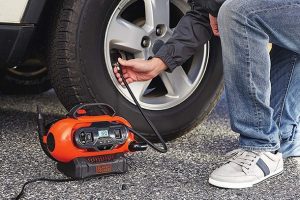
First, plug in the compressor – if needed – and let it accumulate air. Then, place the compressor near the flat tire. The air hose has to be attached to the compressor and have a quick coupler at the end as well.
The quick coupler lets you push air through the valve stem. If you notice a safety position on the compressor’s nozzle, activate it. Lastly, secure the hose to the tire’s valve stem and turn on the compressor.
Depending on your type of compressor, you may have to manually turn off the machine, use the gauge to read the amount of air that is in the tire, or the compressor may turn itself off when a certain pressure level is reached.
Hose Detaching
Once you have the right amount of air in the tire, you can safely remove the hose from the compressor. You will hear a short hissing noise when you do so, as the valve stem gets back into its natural no-flow position.
Then, put the stem cap that you carefully removed earlier back on the valve.
The Bottom Line
We highly recommend that you check the tire pressure as you fill the tire with an air compressor. If you think you added too much air, then you can push on the tire gauge in order to release some of it.
It is important that you add just enough air into the tire so that you avoid any other complications. Overall, the process is rather easy, but does require quite a bit of information and knowledge, mainly because an overinflated tire can be dangerous!